
Thailand Urges New Global Order as BRICS Meets Under Shadow of Iran Conflict
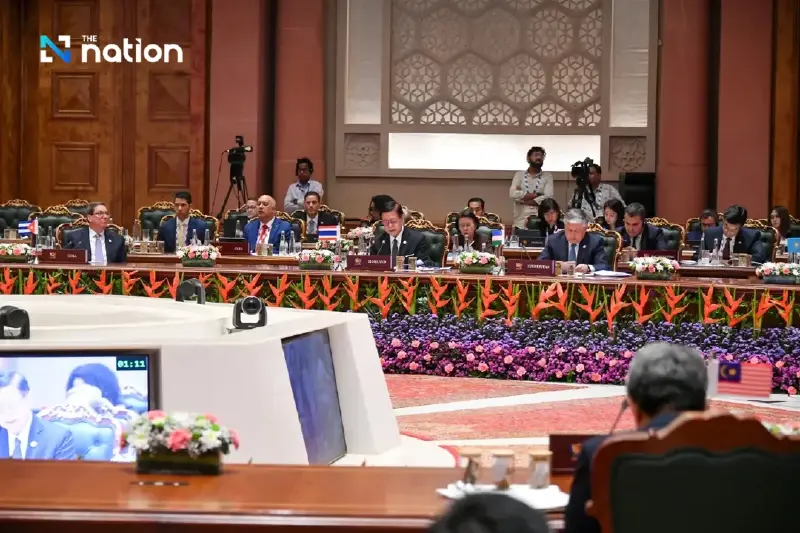


Minister Sihasak warns that Western-led global rules are failing, as Thailand seeks stronger regional ties and energy security amid Middle East war
- At a BRICS+ summit, Thailand's Foreign Minister called for a new, more inclusive global order, arguing that the current Western-led rules are outdated and no longer reflect modern geopolitical realities.
- Thailand's call is directly linked to the conflict in the Middle East, which the minister warned poses a significant threat to energy and food security for the entire ASEAN region.
- The conflict's presence was evident at the meeting, where Iran's representative accused the UAE of military involvement and urged BRICS members to resist "Western hegemony."
- The summit underscored the BRICS bloc's ambition to formalize its role as a counterweight to Western influence and create a "multipolar" world where emerging economies have a greater say.
Minister Sihasak warns that Western-led global rules are failing as Thailand seeks stronger regional ties and energy security amid the Middle East war.
Thailand has called for a more inclusive international order that reflects the rise of emerging economies, as foreign ministers from the BRICS+ grouping gathered in the Indian capital amid escalating tensions in the Middle East.
Addressing the summit in New Delhi on Thursday, Thailand’s Deputy Prime Minister and Minister of Foreign Affairs, Sihasak Phuangketkeow, argued that the current global rules—established largely by Western powers post-1945—no longer reflect modern geopolitical realities.

He stressed that developing nations must play a greater role in shaping a "multipolar" world.
"The current global order is being challenged by superpowers who no longer wish to be bound by international rules," Sihasak said, citing the ongoing violence in the Middle East as a primary concern.
He warned that the conflict poses a direct threat to energy and food security not only for Thailand but also for the entire ASEAN region.

Maritime Security and Regional Stability
The summit, marking the 20th anniversary of BRICS, opened with a plea from Indian Foreign Minister Subrahmanyam Jaishankar for "safe and unimpeded maritime flows."
His comments come as the Strait of Hormuz, a vital artery for a fifth of the world’s oil and gas, remains under a blockade.
Echoing these concerns, Sihasak emphasised that Thailand seeks a peaceful resolution in the Middle East through dialogue. He also used the platform to signal a strategic pivot towards Africa—represented at the talks by Ethiopia, Nigeria, and Egypt—noting that the continent represents a critical "new market" for Thai economic interests.


Bilateral Success: Thailand and India
On the sidelines of the summit, Sihasak held bilateral talks with his Indian counterpart to strengthen the Thailand-India strategic partnership. The discussions highlighted a significant economic boom:
Trade Volume: Bilateral trade has surged by 25%, reaching $21.4 billion.
Tourism: Indian arrivals in Thailand have reached approximately 2.5 million, a key pillar of the post-pandemic recovery.
Strategic Bridge: Both ministers agreed that Thailand serves as a vital gateway connecting India’s "Act East" policy with the ASEAN bloc.

Tensions Flare Between Iran and UAE
While Thailand focused on cooperation, the summit was punctuated by a sharp diplomatic rift between member states. Iranian Foreign Minister Abbas Araqchi used the forum to accuse the United Arab Emirates (UAE) of "direct involvement" in military operations against Iran.
In a rare and tense encounter, Araqchi urged BRICS members to condemn the actions of the United States and Israel, following the outbreak of war on 28 February.
He called on the grouping to resist what he described as "Western hegemony and the sense of impunity" held by Washington.
The New Delhi meeting serves as a precursor to the BRICS leaders' summit scheduled for the second half of the year, where the bloc is expected to further formalise its role as a counterweight to Western influence.
