
Trump and Xi discuss Iran war, Taiwan and trade during Beijing visit
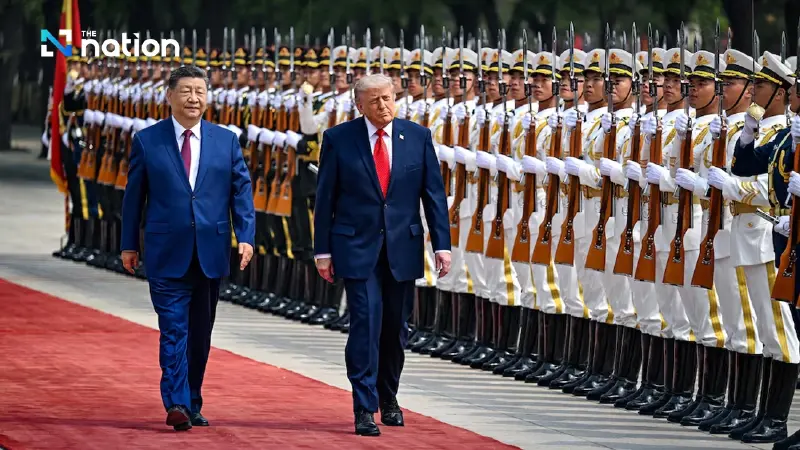


The US president says his patience with Tehran is running out as Beijing criticises the war, trade pledges underwhelm investors and maritime incidents deepen tensions.
- President Trump sought President Xi's assistance in ending the war with Iran and reopening the Strait of Hormuz, with Xi reportedly agreeing Iran should not obtain nuclear weapons and promising not to send military equipment to Tehran.
- On trade, the leaders announced deals for China to purchase US farm goods and 200 Boeing jets, though the aircraft order was smaller than markets anticipated and no breakthrough was made on advanced AI chip sales.
- President Xi delivered a sharp warning that mishandling the issue of Taiwan, which Beijing claims as its territory, could lead to conflict.
US President Donald Trump entered his final talks with Chinese President Xi Jinping in Beijing on Friday (May 15) with promised economic wins giving markets little to cheer, while seeking Chinese help over the costly and unpopular war with Iran after saying his patience with Tehran was running out, and a ship was reported seized by Iranian personnel off the United Arab Emirates.
Trump is making the first visit by a US president to China, America’s main strategic and economic rival, since his previous trip in 2017, and has been seeking tangible results to bolster dented approval ratings ahead of crucial midterm elections in November.
“We've made some fantastic trade deals, great for both countries,” Trump said, seated beside Xi in a decorative red armchair at the opulent Zhongnanhai complex, a former imperial garden that houses the offices of Chinese leaders.
Earlier, the two leaders had chatted and strolled outside, with Trump remarking on the beautiful roses and Xi promising to send him seeds for the flowers, before a lunch of lobster balls, Kung Pao scallops and shrimp dumplings.
As Trump prepared for the final meeting, China’s foreign ministry issued a blunt statement on the Iran war. “This conflict, which should never have happened, has no reason to continue,” it said, adding that China was supporting efforts to reach a peace deal in a war that has severely affected energy supplies and the global economy. At Zhongnanhai, Trump said the leaders had discussed Iran and felt “very similar”, though Xi did not comment.
The White House said Trump and Xi had agreed during talks in Beijing on Thursday (May 14) that the Strait of Hormuz should be open, and a brief US summary of the talks highlighted what it called the leaders’ shared desire to reopen the shipping lane. It said Xi made clear China’s opposition to the militarisation of the strait and any effort to charge a toll for its use, expressed interest in buying more American oil to reduce China’s future dependence on the strait, and agreed with Trump that Iran should never obtain nuclear weapons. Tehran has denied seeking such weapons.
Trump said Xi had also promised not to send Iran military equipment. “He said he’s not going to give military equipment, that’s a big statement,” Trump told Fox News’ “Hannity” programme. Trump had been expected to urge China to convince Iran to make a deal with Washington, but analysts doubt Xi will be willing to push Tehran hard or end support for its military, given Iran’s value to Beijing as a strategic counterweight to the US.
Iran effectively shut the Strait of Hormuz in response to US-Israeli attacks that began on 28 February, causing an unprecedented disruption to global energy supplies. China is close to Iran and the main buyer of its oil, and in normal times, about a fifth of global oil and liquefied natural gas supplies pass through the waterway. The US paused its attacks on Iran last month but began a blockade of the country’s ports, while talks aimed at ending the conflict have stalled with Iran refusing to end its nuclear programme or relinquish its stockpile of enriched uranium. Diplomacy has been on hold since last week, when Iran and the US each rejected the other’s most recent proposals.
“I am not going to be much more patient,” Trump said on “Hannity” on Thursday night. “They should make a deal.” On the key issue of Iran’s hidden stockpile of enriched uranium, Trump suggested it only needed to be secured by the US for public relations purposes. “I don't think it's necessary except from a public relations standpoint,” he said. “I just feel better if I got it, actually. But it's, I think, it's more for public relations than it is for anything else.”
US Treasury Secretary Scott Bessent, speaking to CNBC from Beijing, said he believed China would “do what they can” to help open the strait, something “very much in their interest.” Trump is keen to draw Chinese support for ending a war that has become an electoral liability as it drags on towards the US midterm elections in November.
The tensions on the trade route escalated after an Indian cargo vessel carrying livestock from Africa to the UAE was sunk on Wednesday in waters off the coast of Oman. India condemned the attack and said all 14 crew members had been rescued by the Omani coast guard. Vanguard, a British maritime security advisory firm, said the vessel was believed to have been hit by a missile or drone, causing an explosion.
Separately, the British maritime security agency UKMTO reported on Thursday that “unauthorised personnel” had boarded a ship anchored off the coast of the UAE port of Fujairah and were steering it towards Iran. Vanguard said a company security officer had reported that “the vessel was taken by Iranian personnel while at anchor.” Fujairah is the UAE’s sole oil port, on the Gulf of Oman just outside the Strait of Hormuz, and enables some shipments to reach markets without passing through the chokepoint.
Iran appears to be making more deals with countries to allow some ships to pass through the Strait if they accept Tehran’s terms. A Japanese tanker crossed on Wednesday after Japan’s prime minister announced that she had requested help from the Iranian president. A huge Chinese tanker also crossed on Wednesday, and Iran’s Fars news agency reported on Thursday that an agreement had been reached to let some Chinese ships pass.
Iran’s Revolutionary Guards said 30 vessels had passed through the strait since Wednesday evening, still far short of the 140 on a typical day before the war but a substantial increase if confirmed. According to shipping analytics firm Kpler, about 10 ships had sailed through the strait in the past 24 hours, compared with five to seven that have crossed daily in recent weeks.
On trade, US officials said deals had been agreed to sell farm goods, beef and energy to China, with progress on setting up mechanisms to manage future trade, and both sides were expected to identify US$30 billion of non-sensitive goods. But there were scant details and no sign of a breakthrough on selling Nvidia’s advanced H200 AI chips to China, despite Nvidia chief executive Jensen Huang’s dramatic last-minute addition to the trip.
Trump told Fox News that China had agreed to order 200 Boeing jets, its first purchase of US-made commercial jets in nearly a decade. That was far short of the roughly 500 aircraft that markets had expected, and Boeing shares fell more than 4%. “For the market, the summit can be strategically reassuring while underwhelming in substance,” said Chim Lee, senior China analyst at the Economist Intelligence Unit.
The summit’s main achievement may be maintaining a fragile trade truce struck when the leaders last met in October, when Trump suspended triple-digit tariffs on Chinese goods while Xi backed away from choking off supplies of vital rare earths. US Trade Representative Jamieson Greer, who is accompanying Trump, told Bloomberg TV on Friday that it had not yet been decided whether to extend the truce beyond its expiry later this year.
Xi’s remarks to Trump that mishandling Taiwan, the democratically governed island Beijing claims, could lead to conflict delivered a sharp, if not unprecedented, warning during a summit that otherwise appeared friendly and relaxed. Taiwan, which lies just 50 miles (80 km) off China’s coast, has long been a flashpoint in US-China ties, with Beijing refusing to rule out the use of military force to gain control of the island and the United States bound by law to provide Taipei with the means to defend itself.
“US policy on the issue of Taiwan is unchanged as of today,” Secretary of State Marco Rubio, who is travelling with Trump, told NBC News, adding that the Chinese “always raise it ... we always make clear our position, and we move on.” Taiwan Foreign Minister Lin Chia-lung thanked the United States on Friday for repeatedly expressing its support.
At Thursday’s lavish state banquet, Xi said the China-US relationship was the most important in the world. “We must make it work and never mess it up,” he said.
Rubio also said Trump had raised with Xi the case of Hong Kong’s most vocal China critic, media tycoon Jimmy Lai, who was sentenced in February to 20 years in jail in the Asian financial hub’s biggest national security case. “The president always raises that case and a couple others, and obviously we’ll hope to get a positive response from that,” Rubio told NBC News. “We'd be open to any arrangement that would work for them, as long as he's given his freedom,” he said of Lai, who has denied all the charges against him. China’s foreign ministry has previously said, when asked about Lai, that Hong Kong affairs are an internal matter for China.
Thousands of Iranians were killed in US and Israeli air strikes in the first weeks of the war, and thousands more have been killed in Lebanon since the war reignited fighting between Israel and the Iran-backed group Hezbollah. Talks between Lebanese and Israeli officials in Washington on Thursday were productive and positive, according to a senior State Department official, who said they were set to continue on Friday.
Trump said his aims in starting the war were to destroy Iran’s nuclear programme, end its ability to attack neighbours and make it easier for Iranians to overthrow their government. A senior US admiral told a US Senate committee on Thursday that Iran’s ability to threaten its neighbours and US regional interests had been “significantly degraded”. “They no longer threaten regional partners, or the United States, in ways that they were able to do before, across every domain,” Admiral Brad Cooper said. But Cooper declined to directly address reports by Reuters and other news organisations that Iran had retained significant missile and drone capabilities.
Iran’s rulers, who used force to put down anti-government protests at the start of the year, have faced no organised opposition since the war began, and their closure of the strait has given them additional leverage in negotiations. Washington wants Tehran to hand over the uranium and forgo further enrichment, while Iran is seeking the lifting of sanctions, reparations for war damage and acknowledgement of its control over the strait.
Reuters
