
Draft US-Iran framework could restore Hormuz shipping within a month
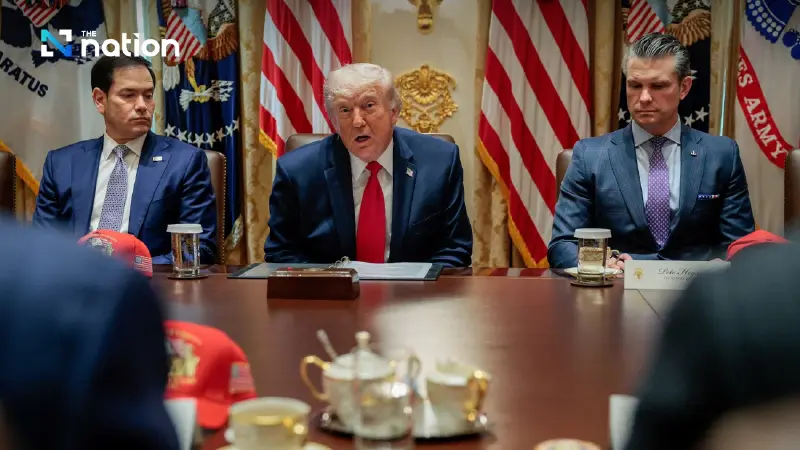


Tehran said it would await tangible verification before acting, as Trump rejected any joint control of the strategic waterway.
- A draft preliminary framework between the US and Iran proposes to restore commercial shipping through the Strait of Hormuz to pre-war levels within one month.
- Under the terms, Iran would reopen the strait in exchange for the US withdrawing military forces from nearby areas and lifting its naval blockade of Iranian ports.
- The agreement is not finalised and faces significant disagreement, particularly over a provision for joint Iran-Oman management of the strait, which the US President has publicly rejected.
- Iran has stated it will not act on the draft framework until it receives "tangible verification" that all parties are complying with the conditions.
Iranian state television reported that it had received an unofficial draft preliminary framework of understanding between Iran and the United States aimed at ending the continuing conflict, with one key element being the restoration of commercial shipping through the Strait of Hormuz to pre-war levels within one month.
Under the draft agreement, Iran would reopen commercial shipping in the Strait of Hormuz, a strategic global energy route, while the United States would withdraw military forces from areas near Iran and lift its naval blockade of Iranian ports.
Iranian state media said the framework had not yet been finalised, and that the Tehran government would take no action until there was “tangible verification” to confirm that all parties were actually complying with the conditions.
The agreement also states that the management of shipping in the Strait of Hormuz would be carried out under co-operation between Iran and Oman, excluding military vessels, and that if a final agreement could be reached within 60 days, it could be endorsed as a binding resolution of the United Nations Security Council.

The report added that the memorandum of understanding between the United States and Iran stemmed from indirect talks that began after the war broke out in February, with Pakistan playing a key role as mediator between Tehran and Washington.
However, US President Donald Trump appeared to reject reports that Iran and Oman would jointly manage shipping in the Strait of Hormuz, saying no country could control the international waterway.
“No one is going to control this strait. It is international waters, and Oman will have to act like every other country. Otherwise, we may have to take decisive action,” Trump said during a cabinet meeting in front of the media.
The remarks were seen as a signal of pressure on Oman, even though the United States and Oman have had military and economic ties for many decades.
Ebrahim Azizi, chairman of the National Security Committee of Iran’s parliament, said Trump’s threatening rhetoric would not make Iran retreat from its core demands, including the right to enrich uranium, authority over the Strait of Hormuz and the lifting of sanctions.
“It is clear that Trump is trying to find a way out of a strategic deadlock by alternating between threats and calls for an agreement,” Azizi said on X.

The conflicting positions of the two sides show that, although the White House has signalled in recent days that a preliminary agreement may be close, the gap between the United States and Iran remains far from a shared conclusion.
The war, which has dragged on for more than three months, has killed thousands of people and sent global energy prices sharply higher since the joint US and Israeli attack on Saturday (February 28, 2026).
Although Trump has repeatedly insisted that a peace agreement is close after a ceasefire took effect in early April, the latest situation remains full of political and international security uncertainty.
