
Sanjiang folk painting exhibition brings Dong culture to Thailand
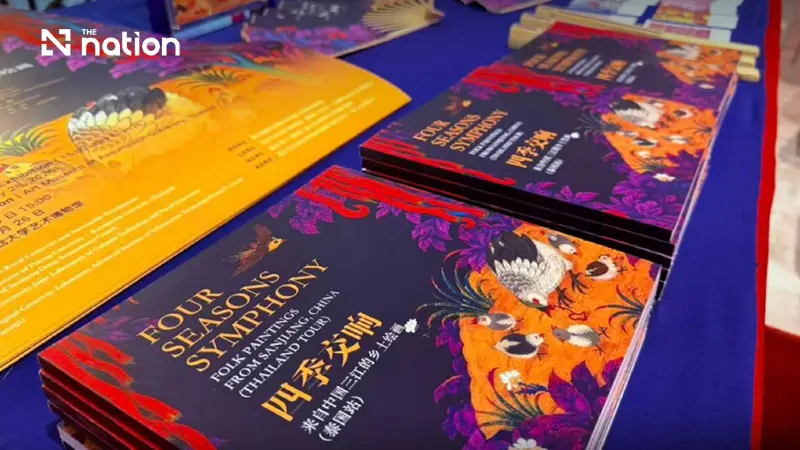


Seasonal scenes from Sanjiang introduce Thai and international audiences to Dong landscapes, customs and daily life as China and Thailand mark 50 years of diplomatic relations.
- An exhibition of folk paintings from China's Sanjiang region is being held at Assumption University in Thailand to showcase the culture of the Dong ethnic group.
- The artworks, organized by the theme of the four seasons, depict the rural landscapes, daily life, and traditions of the Dong people through bright colors and expressive imagery.
- The event is part of a cultural exchange celebrating the 50th anniversary of diplomatic relations between China and Thailand and a collaboration between Peking University and Assumption University.
- In addition to the paintings, the exhibition includes interactive elements like guided tours, youth dialogues, and painting workshops to allow visitors to engage directly with Dong culture.
Seasonal depictions of rural landscapes, customs and everyday life are at the centre of an exhibition introducing the vibrant traditions of Sanjiang’s Dong folk art to an international audience in Thailand.
“Symphony of the Four Seasons: Folk Paintings from China’s Sanjiang” opened at the museum at Assumption University’s Suvarnabhumi Campus on July 6, 2026.
The exhibition brings together folk paintings from Sanjiang in Guangxi, with spring growth, summer flourish, autumn harvest and winter storage providing the narrative linking the collection.
Through bright colours and expressive imagery, the paintings portray the natural surroundings, traditions and daily experiences of the Dong ethnic group, giving Thai audiences an insight into the vitality of China’s rural communities.
The event is part of a series of cultural exchanges marking the 50th anniversary of diplomatic relations between China and Thailand.
In addition to the artworks, the programme includes guided tours, youth dialogue salons, cultural and creative products and painting workshops, allowing international visitors to engage directly with Dong culture.
Held under the guidance of the UNESCO Chair on Rural Creativity and Sustainable Development, the exhibition is jointly organised by Peking University’s Institute for Cultural Industries, Assumption University and the Federation of Literary and Art Circles of Sanjiang Dong Autonomous County.


It also forms part of the “Encountering the Beauty of the East: Peking University Intangible Cultural Heritage Inheritance and Innovation Program”.
At the opening ceremony, Assistant Professor Kitti Phothikitti, vice-president of Assumption University, described art as a universal language capable of transcending national and cultural boundaries.
He said the exhibition both highlighted the Dong people’s rich cultural heritage and reflected contemporary China’s achievements in rural revitalisation and cultural development.
“Assumption University has consistently adhered to an internationalized educational philosophy and has established deep cooperative relationships with many Chinese universities and cultural organizations in recent years. This exhibition is a significant reflection of the deepening cooperation in higher education and cultural exchange between China and Thailand,” he said.
Kitti expressed hope that the exhibition would give Thai students a deeper understanding of Chinese rural art while strengthening friendship among young people from China and Thailand.
Xiang Yong, the exhibition’s curator, a professor at Peking University’s School of Arts and director of its Institute for Cultural Industries, recalled his visits to Dong villages as he explained the decision to structure the exhibition around the changing seasons.
He noted that every ethnic group and region had its own distinctive interpretation of spring, summer, autumn and winter.


“The value of Sanjiang Dong paintings lies not only in their artistic expression but also in the confidence they reflect in China’s rural culture,” Xiang said.
He described the exhibition as the outcome of years of academic cooperation and mutual trust between Peking University and Assumption University, and voiced hope that the partnership would develop further in the fields of rural creativity and sustainable development.
Chen Yuqiu, chairman of the Sanjiang Artists Association, introduced Sanjiang as the only Dong autonomous county in Guangxi and the home of the largest Dong population among China’s five Dong autonomous counties.
“Sanjiang folk painting is known for its distinctive themes, exaggerated forms, and bright colours,” she said.
Chen explained that the art form preserved the cultural memory of the Dong people while continuing to develop through village-based creative programmes, art education in schools and partnerships with universities.
Together, these efforts have helped cultivate successive generations of artists.
She also invited Thai visitors to travel to Sanjiang to experience the traditions of the Dong community firsthand.
Following the opening, Chinese and Thai scholars and artists joined a youth dialogue salon focusing on Sanjiang Dong paintings.
Six guests examined the art form from their respective academic and cultural perspectives.
Chen later led an interactive workshop in which she explained the creative concepts behind her paintings before inviting students to produce their own interpretations using traditional Dong-inspired patterns and designs.
The workshop allowed participants to explore the colourful folk art through their own creativity while experiencing an important element of China’s living cultural heritage.

Source: China Daily
