
Engineering a Cleaner Future
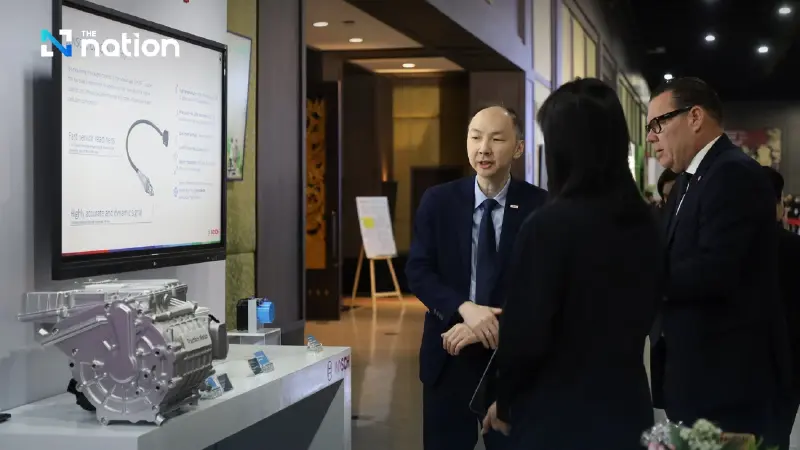


Bosch leverages its advanced mobility and energy efficiency technologies to provide tangible solutions for better air quality
- Bosch is leveraging its advanced technologies in mobility and energy efficiency to provide tangible solutions for improving air quality.
- The company is advancing vehicle electrification with its eAxle, an integrated electric drive system, while also reducing emissions from all vehicles with regenerative braking and advanced exhaust-gas aftertreatment solutions.
- Bosch also implements its own smart factory (Industry 4.0) principles in its manufacturing facilities to optimize energy consumption and reduce its industrial carbon footprint.
Bosch leverages its advanced mobility and energy efficiency technologies to provide tangible solutions for better air quality.
In an era where urban air quality and climate action are pressing global concerns, technology leader Bosch is focusing its expertise on engineering tangible solutions.
With cities worldwide, including Bangkok, frequently grappling with high levels of fine particulate matter (PM2.5), the role of technology in mitigating pollution has never been more critical.

At the recent Thailand National PM2.5 Forum, Bosch showcased how its advanced technologies contribute to cleaner air, a commitment explained by Robert Hesse, Bosch Southeast Asia and Oceania President:
Our long-standing commitment to Thailand is centered on engineering tangible solutions that contributes towards the nation's environmental challenges," noted Robert Hesse, Regional President of Bosch in Southeast Asia and Oceania. "From optimizing conventional engines to accelerating vehicle electrification, our focus is on deploying a diverse portfolio of advanced technologies that improve air quality for all."

The timing of the event lent a powerful backdrop to the discussions, as noted by Joseph Ngo Hong, Managing Direct of Bosch Thailand, Laos, Cambodia and Myanmar:
"Our participation in the first Thailand National PM2.5 Forum in Chiang Mai underscored Bosch Thailand's strong commitment to addressing air quality challenges, particularly within the transport sector," remarked Joseph Hong, Managing Director of Bosch Thailand, Laos, Cambodia, and Myanmar. "Against the backdrop of real-time air quality warnings, the discussions powerfully highlighted the imperative for immediate and effective technological intervention. We are dedicated to continued support in the future, providing advanced solutions integral to safeguarding public health and driving a cleaner future for Thailand."
It is within this context of coordinated action that Bosch presents its technological contributions. A key highlight was the Bosch eAxle, an all-in-one electric drive solution for battery-electric and hybrid vehicles.
The eAxle integrates the electric motor, power electronics, and transmission into a single compact unit, supporting electrification across a wide range of vehicles, from passenger cars to light commercial vehicles.
Its modular design reduces complexity and cost, improves efficiency, and increases driving range by making better use of stored battery energy. Silicon carbide semiconductor technology also enhances efficiency without increasing the size of the battery.

In addition, Bosch continues to develop Regenerative Braking Systems, which recover energy during deceleration and convert it into electrical energy for use in the vehicle.
This reduces reliance on conventional friction brakes and significantly decreases brake dust emissions, which contributes to reducing particulate matter from the transportation sector.

Simultaneously, the company's Advanced Exhaust-gas Aftertreatment Solutions are making conventional engines cleaner.
These systems, featuring technologies like double-injection and the Denox system with Selective Catalytic Reduction (SCR), effectively convert harmful nitrogen oxides into simple nitrogen and water.
This not only supports compliance with stricter emissions standards but also directly addresses the widespread pollution that contributes to smog and respiratory health issues.

Furthermore, the ethos of efficiency extends deep into its industrial solutions, as demonstrated in the company's own operations. Bosch's manufacturing facilities in Thailand serve as real-world examples of its smart factory principles.
By implementing connected Industry 4.0 solutions, the company optimizes its energy consumption and reduces its carbon footprint, showcasing a path for the entire industrial sector to contribute to climate action.
Through this focus on concrete technological contributions, Bosch aims to play a key role in building a cleaner, healthier future.
