
SKY Aviation Lab brings real airport systems into the classroom
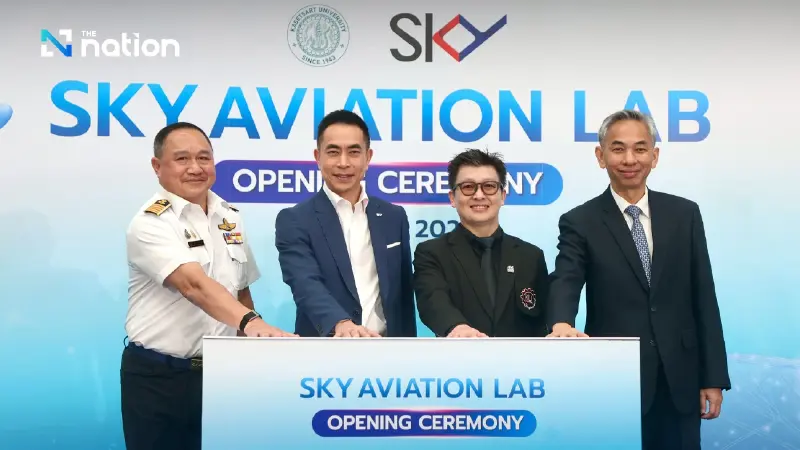


SKY ICT and Kasetsart University have launched the SKY Aviation Lab, giving students hands-on experience with real airport systems to help build aviation talent and support Thailand’s ambition to become a regional aviation hub.
SKY ICT, a leader in information and communications technology systems for the aviation sector, has joined hands with Kasetsart University to launch the “SKY Aviation Lab”, a smart airport laboratory designed to promote student learning through hands-on training with real airport systems.
The lab’s highlight is a Passenger Journey Simulation Zone, which recreates the full passenger process from check-in to boarding. The initiative is intended to help develop the skills of the next generation of aviation personnel and support Thailand’s drive to become a regional aviation hub.
Sithidej Mayalarp, Chief Executive Officer of SKY ICT, said the launch followed the signing of a memorandum of understanding between the company and Kasetsart University to collaborate on research, innovation and workforce development for the aviation industry.
He said Thailand is currently in the midst of rapid growth in the aviation industry and has enjoyed strong strategic advantages since the Covid-19 period, particularly in terms of geography and infrastructure.
“We must keep asking ourselves how Thailand can genuinely move towards becoming a regional aviation hub in the digital era,” he said, adding that 2026 could be a real opportunity for the country to make that ambition a reality.

Sithidej said becoming a hub should not be measured only by the number of flights or passengers arriving from different regions. Instead, he said the focus should be on the intelligence of airport operating systems and on making practical use of airport data to improve services and create the best possible passenger journey.
He said the new lab would allow students to learn from real airport technologies and real-world scenarios, helping prepare a new generation of workers who can step straight into the industry. It would also support an environment conducive to education and research, which in turn would help raise the standard of Thailand’s aviation industry in the future.
He added that such progress would not be possible without cooperation among three key sectors: the government, the private sector and educational institutions. Their combined efforts, he said, would help Thailand become a true aviation hub in the near future.

Smart lab recreates the real airport experience
The SKY Aviation Lab has been designed as a Passenger Journey Simulation Zone where undergraduate and postgraduate students can learn and practise in realistic airport scenarios using modern systems that cover every step from check-in to boarding.
Its facilities include:
- Check-In and Boarding System (CUPPS): a check-in system that links passenger data with airlines and baggage weighing functions, helping manage passengers efficiently before departure.
- Self Check-In Kiosk (CUSS): an automated boarding pass kiosk that allows passengers to complete transactions quickly and conveniently by themselves.
- Self Bag Drop: a self-service baggage drop system that helps reduce waiting times at check-in counters.
- Self Boarding Gate: an automated boarding gate using facial recognition technology, allowing passengers to verify their identity and proceed directly to boarding without repeated document checks.
The lab also features demonstration videos covering the entire process from check-in to boarding, as well as a video showing the Baggage Reconciliation System (BRS), which is used to track and match baggage with passengers.
This is intended to help students understand the overall flow of passenger and data management within an airport.

Aviation lab offers a boost to high-skilled aviation talent
Dr Damrong Sripraram, Acting President of Kasetsart University, said the university was delighted that SKY ICT recognised the importance of workforce development and had stepped in to support the establishment of the SKY Aviation Lab.
He said the lab would help complete the university’s learning ecosystem for both undergraduate and postgraduate students by bringing real airport technology into simulated training environments.
This would strengthen teaching and learning and help produce high-skilled talent capable of driving Thailand towards its goal of becoming a regional aviation hub.

Meanwhile, Dr Navatasn Kongsamutr, Head of the Department of Aerospace Engineering at the Faculty of Engineering, Kasetsart University, said Thailand’s aviation industry was expected to undergo major transformation over the next decade.
He said the International Air Transport Association (IATA) expects Thailand to rank ninth among the world’s top aviation markets, pointing to continued growth in travel demand. At the same time, he said, new technologies and new forms of travel would emerge over the next 10 years, including drones and Advanced Air Mobility (AAM).

To respond to these changes, Kasetsart University is redesigning its curricula around three core competencies:
- Aviation fundamentals: solid technical knowledge of aviation systems
- Digital and data literacy: the ability to use AI, data analysis and digital tools across operational and management roles
- Soft skills and systems thinking: an understanding of aviation ecosystems, linking operational, management and technical perspectives

Navatasn said the SKY Aviation Lab, which simulates real airport operating systems, would be an important tool in helping students see the bigger picture and understand the interconnected nature of the aviation ecosystem in a systematic way.
He said the lab would allow students to study everything from front-end passenger handling using advanced technologies to back-end data management through systems such as the Advance Passenger Processing System (APPS), the Airport Operational Database (AODB) and the BRS.

He added that decision-making based on big data had become central to today’s aviation industry, helping improve the efficiency of Thai airports in line with international standards while also fostering strategic thinking among students and preparing them to move directly into aviation careers upon graduation.
