
German Ambassador Urges Thai Firms to Prepare for EU Carbon Border Tax
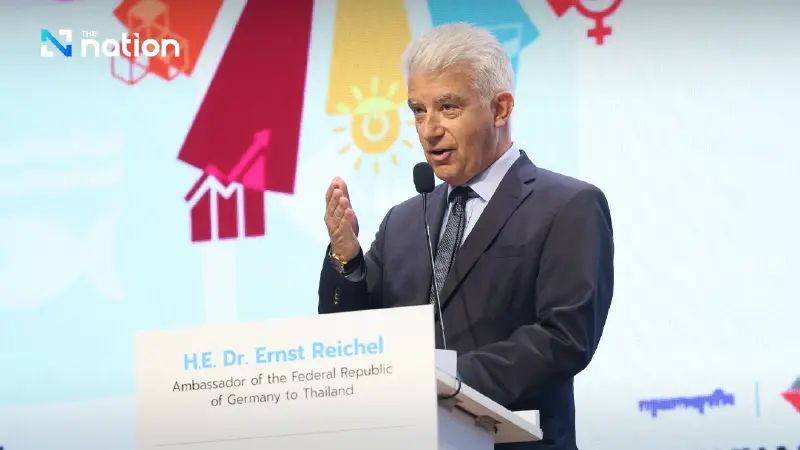


Dr Ernst Reichel warns exporters of steel, aluminium and cement face "massive negative impacts" without early decarbonisation investments
- Germany's ambassador to Thailand has warned that the EU's Carbon Border Adjustment Mechanism (CBAM), starting next year, will require Thai exporters to pay for the carbon emissions embedded in their products.
- The carbon tax will initially impact carbon-intensive sectors such as steel, aluminium, fertilisers, and cement, with non-compliant firms risking a significant loss of competitive advantage.
- The ambassador advised Thai businesses to proactively measure their carbon footprint and invest in clean technologies to prepare for the regulation and potentially gain a competitive edge.
- He noted that if Thailand implements its own domestic carbon pricing system, as planned under its draft Climate Change Act, the EU's border tax would no longer apply to Thai companies.
Dr Ernst Reichel warns exporters of steel, aluminium and cement face "massive negative impacts" without early decarbonisation investments.
Thai exporters risk losing competitive advantage in European markets unless they begin measuring carbon emissions and investing in clean technologies now, Germany's ambassador to Thailand has warned.
Speaking at the Sustainability Forum 2026 organised by Krungthep Turakij on Wednesday, Dr Ernst Reichel said the European Union's Carbon Border Adjustment Mechanism (CBAM), which comes into force next year, will require Thai producers of carbon-intensive goods to purchase certificates matching their embedded emissions.
"Thai exports of CBAM-relevant commodities could see massive negative impacts should they fail to adjust," Dr Reichel told the forum, held under the theme "Regulations for Facilitating Sustainability Goals: Sustainability Know-How, Do It Now".
The mechanism will affect Thai exporters in sectors including steel, aluminium, fertilisers and cement. From next year, importers of these goods into the EU will need to measure, document and verify greenhouse gas emissions embedded in their products.

However, Dr Reichel emphasised that firms investing early in decarbonisation could gain competitive advantages.
"Once Thailand introduces its own emissions trading system, as foreseen under the draft Climate Change Act, and charges high-emitting industries fairly for the climate damage they cause, CBAM will no longer impact Thai businesses because they already pay a carbon price in Thailand," he said.
The ambassador outlined how Germany's sustainability frameworks could serve as models for Thailand, including the Federal Climate Protection Act, which aims to reduce greenhouse gas emissions by at least 65 per cent versus 1990 levels by 2030, and the Supply Chain Due Diligence Act, requiring companies to identify environmental and human rights risks across their operations.
He noted that Thailand's draft Climate Change Act, which has passed Cabinet, would provide the regulatory certainty critical for businesses and investors committed to decarbonisation.

Dr Reichel revealed that through Germany's International Climate Initiative (IKI), his country has become Thailand's largest bilateral partner in climate policy, supporting projects ranging from green energy and low-carbon transportation to the drafting of Thailand's first Climate Change Act and national taxonomy for climate-friendly investments.
"Germany and Thailand started a formal Thai-German energy dialogue between our respective government ministries this year," he added.
The ambassador advised Thai businesses to begin measuring carbon emissions before regulations require it, invest in energy efficiency and clean technologies, adopt transparent ESG reporting practices, and seek partnerships for green technology transfer.
He also linked sustainability compliance to trade opportunities, noting that ongoing negotiations on a free trade agreement between Thailand and the EU include provisions on trade and sustainable development.

"Concluding a free trade agreement with the EU and upgrading its sustainability framework goes hand in hand, and one is difficult to imagine without the other," Dr Reichel said.
Germany has established the Climate Club to help countries manage the transition, offering Thailand access to technical and financial assistance through an exclusive matchmaking platform.
"The sustainability landscape is no longer a distant optional concern," Dr Reichel concluded. "With global investors and markets increasingly demanding ESG compliance and climate change posing an existential threat, the time for Thai businesses and policymakers to act is now."
