
UN Warns of 'Development Emergency' as Thailand Leads ASEAN in Sustainability Goals
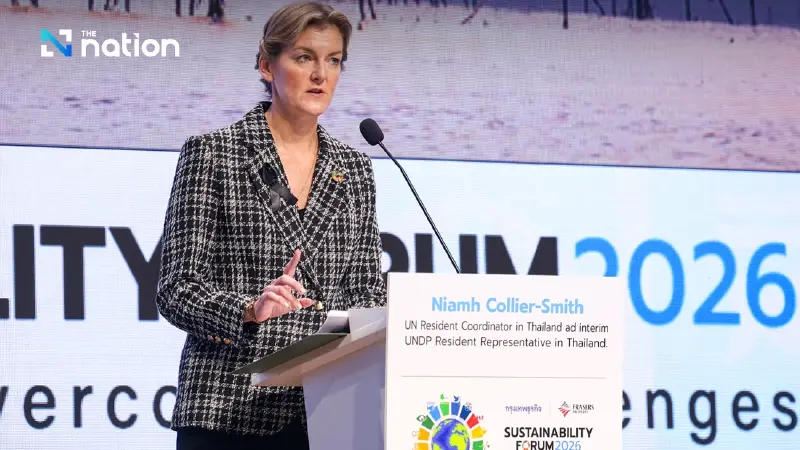


UN coordinator calls for stronger public-private partnerships to meet 2030 targets as climate finance needs surge to 1.4tn baht annually
- The UN has declared a "development emergency," warning that progress on its Sustainable Development Goals (SDGs) is critically slow, with nearly half of the goals off-track as the 2030 deadline approaches.
- Despite the global alert, Thailand is recognized as a leader in sustainability, ranking first in ASEAN for the seventh consecutive year due to progress in areas like poverty reduction and EV adoption.
- To accelerate efforts, the UN is urging Thailand to foster stronger public-private partnerships to address a massive annual SDG financing need that has surged to at least 1.4 trillion baht.
The UN coordinator calls for stronger public-private partnerships to meet 2030 targets as climate finance needs surge to 1.4 trillion baht annually.
The United Nations has issued an urgent call for accelerated action on sustainable development goals, warning that nearly half are progressing too slowly whilst 18 per cent are moving backwards, as Thailand grapples with devastating floods across the region.
Speaking at the Sustainability Forum 2026 in Bangkok on Thursday, Niamh Collier-Smith, UN Resident Coordinator in Thailand ad interim and UNDP Representative, stressed that achieving the 17 Sustainable Development Goals (SDGs) within the next five years would require unprecedented collaboration between government, private sector, and civil society.
"We are living in a development emergency," Collier-Smith told forum attendees. "2030 is less than five years away and the clock is not slowing down."

Despite the challenges, Thailand continues to lead the region in sustainability progress, ranking 43rd globally and first in ASEAN for the seventh consecutive year.
The country has reduced poverty by nearly 85 per cent in one generation, with universal health coverage now reaching 99 per cent of the population.
Thailand's electric vehicle adoption has also surged, with 684,000 EVs on the roads in 2023, contributing an estimated 344,000 tonnes of carbon dioxide emission reductions—equivalent to removing 75,000 fossil fuel-powered cars from circulation.
However, the UN coordinator highlighted that Thailand's annual SDG financing needs have risen from 1.27 trillion baht pre-COVID to 1.4-2.5 trillion baht today, requiring a fundamental shift in how sustainable development is funded.

"Traditional development aid is very important, but it's far from enough," Collier-Smith stated, pointing to the private sector's crucial role. "Private sector capital is larger, faster, and more innovative than any source of funding available."
The speech came as Thailand and neighbouring countries—Sri Lanka, Indonesia, and Malaysia—continue recovery efforts from severe flooding. UN Secretary-General António Guterres has pledged support for government response efforts across the affected regions.

Collier-Smith outlined three priority areas for immediate action: unlocking sustainable finance for the SDGs, investing in a just energy transition, and building trust through partnerships for systemic change.
On the energy transition, she noted that whilst it could create 172,000 new jobs in renewables by 2035, Thailand faces a skills gap. Currently, only 14 per cent of workers in the sector operate at high-skill levels, significantly behind neighbours such as Malaysia and South Korea.
"For an energy transition that is just, people are at the heart of the sustainable development goals," Collier-Smith emphasised.
She called for investment in education systems fostering digital literacy and STEM proficiency, alongside support for workers through upskilling and reskilling programmes.
The coordinator also highlighted Thailand's progress on OECD accession and free trade agreement negotiations with the European Union, noting that compliance with new EU regulations—including the Carbon Border Adjustment Mechanism and corporate sustainability due diligence directive—should be viewed as "a gateway to long-term competitiveness" rather than a burden.

Members of the UN Global Compact Network Thailand, led by Suphachai Chearavanont of CP Group, have committed $46 billion in pledges to accelerate the SDGs, alongside targets for carbon neutrality by 2050 and human capital investment for one million people.
"The choices you make today will shape the society that we live in tomorrow," Collier-Smith concluded, reaffirming the UN country team's readiness to partner with Thailand's private sector on the sustainability agenda.
