
Thailand Enforces Sweeping Ban on Electronic Waste Imports
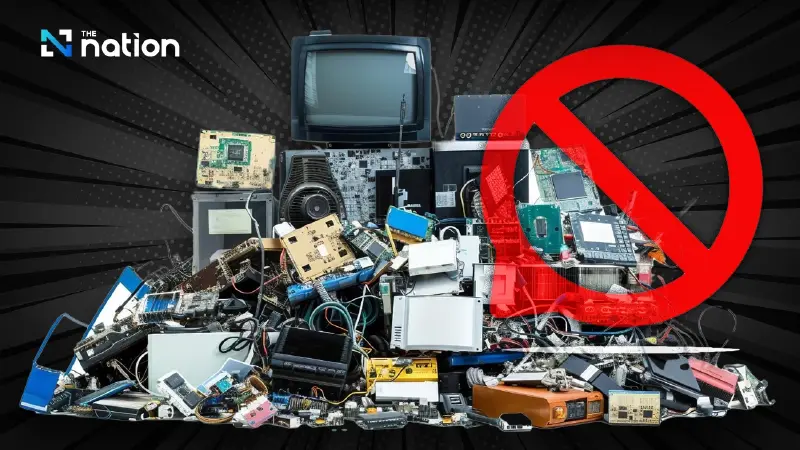


New legislation, effective from June 24th, 2025, significantly expands the list of prohibited items in a decisive move to protect the environment and affirm that "Thailand is not the world's rubbish bin"
Thailand has taken a pivotal step towards sustainable environmental management with the implementation of a comprehensive ban on electronic waste imports.
A new Ministerial Notification from the Ministry of Commerce, classifying e-waste as illegal for admission into the Kingdom, went into effect on June 24th, 2025, following its publication in the Royal Gazette that same day.
This latest decree supersedes a previous 2020 regulation, significantly updating and expanding the scope of the ban. The number of prohibited electronic waste items has increased from 428 to 463.
This broader coverage now includes a wider array of end-of-life electronic equipment such as faulty circuit boards, used lithium batteries, non-functional mobile phones, and small electrical appliances containing hazardous residues.
Furthermore, customs tariff codes have been revised to align with the Harmonized System 2022, a measure designed to prevent false declarations and the illicit smuggling of e-waste in disguised forms.
Defining Hazardous E-Waste
Under the new legislation, "electronic waste" is defined as parts or remnants of defunct electrical and electronic equipment, excluding those from power generators.
This category commonly includes dangerous components such as capacitors, various types of batteries, mercury-containing switches, and specific types of glass from cathode ray tubes.
Crucially, the ban also encompasses capacitors containing Polychlorinated Biphenyls (PCBs) or those contaminated with hazardous chemicals like cadmium, mercury, and lead.
These substances fall under a list of hazardous materials specified by the Ministry of Industry's 2013 notification under the Hazardous Substances Act.
The updated Ministry of Commerce notification specifically targets e-waste classified under Customs Tariff Headings 84 and 85, particularly statistical code 899, to safeguard public health and the environment from toxic residues.
Addressing a Growing Environmental Crisis
The ban comes as Thailand grapples with a burgeoning e-waste problem.
A 2021 report from the Pollution Control Department revealed that the country generates over 400,000 tonnes of domestic electronic waste annually.
Worryingly, only approximately 500 tonnes – a mere 0.125% – are collected and disposed of in an environmentally sound manner. The vast majority often remains in homes, is sold as second-hand goods, or enters informal recycling channels.
Compounding this internal challenge, Thailand has also experienced a dramatic surge in e-waste imports. Figures show a leap from around 900 tonnes imported in 2014 to more than 50,000 tonnes by 2017.

Investigations have also uncovered instances of factories and businesses improperly dismantling e-waste, leading to the leakage of highly toxic substances and heavy metals, including lead, mercury, and cadmium, which contaminate soil, water, and air, posing significant health risks.
This decisive action marks a crucial turning point in Thailand's approach to electronic waste management. By shutting the door on foreign e-waste, the government underscores its firm stance that "Thailand is not the world's rubbish bin," signalling its genuine commitment to a circular economy and environmental sustainability.
