
Myanmar rare earth mines surge in rebel-held areas, fuelling toxic risks


When it comes to rare earths, the world almost instinctively looks to China. The country is not only the global leader in rare earth processing, accounting for more than 90% of global capacity, but also holds the world’s largest reserves.
According to Krungthep Turakij, China had an estimated 44 million tonnes of rare earth reserves in 2024 — nearly half of the world’s total of around 90 million tonnes.
Yet Myanmar has also emerged as a key producer, mining some 31,000 tonnes in 2024, or 8% of global supply, ranking third after China and the United States.
In the four years prior to the 2021 coup, Myanmar exported rare earths worth about US$665 million to China. After 2021, exports skyrocketed more than five-fold to US$3.6 billion by 2024.
But a turning point came in October 2023 when anti-government forces expanded their offensives nationwide.
Satellite images reveal rapid expansion
Recent analysis suggests rare earth mining is accelerating in areas controlled by local militias or armed groups, where government or international oversight is absent.
On August 25, the Shan Human Rights Foundation released findings based on satellite imagery and video footage, identifying 19 large-scale rare earth mines operating under the control of the National Democratic Alliance Army (NDAA) in Mong Yawng, eastern Shan State, just 40 kilometres from the Mekong River.
Satellite records from early 2021 showed only three mines in the area, all of which have since been abandoned. The 19 new sites discovered in 2025 highlight a dramatic expansion in just four years.
Political backdrop
All 19 mines are in territory governed by the NDAA, which has run Special Region 4 since a ceasefire agreement with Myanmar’s military junta in 1989.
In addition to rare earths, manganese mining has also been detected along the Lwe River, with an unbroken eight-kilometre stretch of activity along ridges marking the Myanmar–China border. This has contributed to significant water contamination.
In-situ leaching leaves scars
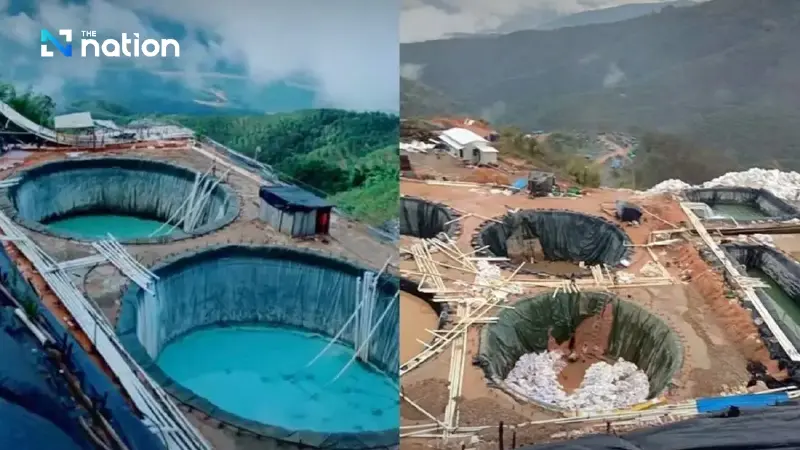
The 19 rare earth mines now operating feature multiple concentric circular ponds, a hallmark of in-situ leaching — a highly destructive mining method also observed in Kachin State.
Videos posted by workers from NDAA territory show the leaching process in action, with thousands of chemical sacks and networks of pipes used to inject leaching agents into the mountainside to extract minerals.

Expanding to meet high demand
Sixteen of the mines are already operational, while three more are in early construction stages, with terraced circular pits under development. This reflects increasingly systematic and large-scale planning.
Images taken in May 2025 show continuing expansion, driven by surging demand for rare earths — crucial inputs for clean energy technologies and advanced electronics.
Environmental toll on the Mekong
Most mines sit at elevations of 4,000–5,000 feet, just four kilometres from the Chinese border. Wastewater from the operations drains into mountain streams that flow south into the Lwe River, a tributary of the Mekong.
Four additional mines south of the Lwe also release waste directly into the river.
The Lwe meets the Mekong at Sop Lwe, opposite Luang Namtha Province in Laos, 125 kilometres northeast of the Golden Triangle, where the borders of Laos, Myanmar and Thailand converge.
