
Enactus World Cup: How 50 Years of Youth Empowerment Is Shaping the Future of Sustainable Business
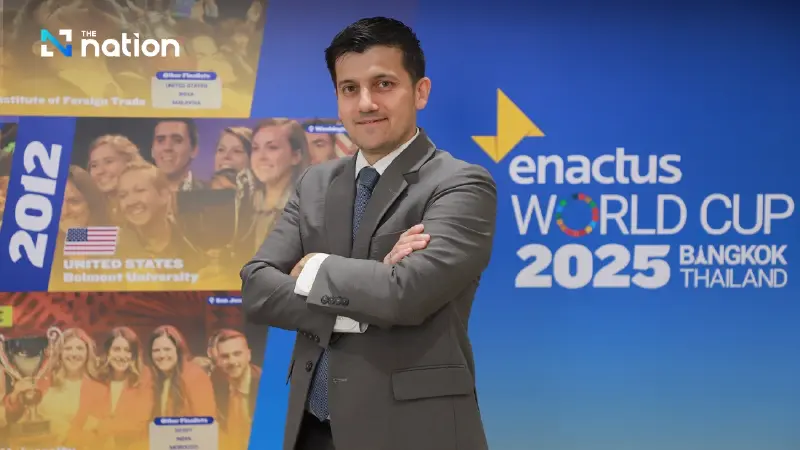


George Tsiatis reflects on Enactus' evolution from US programme to global movement empowering student entrepreneurs across 33 countries
- For 50 years, Enactus has empowered young people by providing a platform and resources to develop sustainable businesses that address social and environmental challenges.
- The organization uses an experiential learning model where student teams create innovative projects, such as a Thai initiative turning cacao waste into methane-reducing animal feed.
- The Enactus World Cup, currently hosted in Bangkok, serves as a global stage for over 1,000 student entrepreneurs to showcase their ventures to business leaders.
- The event aims to reverse typical power dynamics by centering youth voices, demonstrating their potential to create transformative solutions and encouraging investment in their sustainable enterprises.
For half a century, Enactus has been built on a simple but powerful premise: give young people the platform, resources, and support they need, and they will create transformative solutions to the world's most pressing challenges.
As Bangkok hosts the Enactus World Cup for the first time, that belief is being validated by over 1,000 student entrepreneurs from across the globe.
"This event brings business leaders to see and experience and understand how much creativity, how much innovation, how much transformational power young people have," says George Tsiatis, CEO of Enactus Global, speaking at the competition running from 25–28 September at the Queen Sirikit National Convention Centre as part of the Sustainability Expo 2025.
The milestone gathering marks 25 years since the competition first brought together student teams from across the globe—a journey that began much earlier, in 1975, when the organisation was founded in the United States under the name Students In Free Enterprise (SIFE).
"That was a moment really where the organisation was trying to reflect that this isn't just about free enterprise," Tsiatis explains. "This is about entrepreneurship and entrepreneurial action—how you can have a social purpose and a very strong business model and how those can come together to build a better world."
At the heart of Enactus is experiential learning. Students work in teams, often collaborating with local communities to develop projects that apply business principles to social and environmental challenges.
The structure varies by country—some universities integrate Enactus into curricula, whilst others run it as extracurricular clubs—allowing for cultural adaptation whilst maintaining core principles.
"You can't be a global organisation and just have one approach," Tsiatis notes. "The countries have a lot of ability to customise how the learning happens and how they teach and support their students to adapt to the local context."
The results can be extraordinary. Through partnerships with organisations like Resolution Project, which provides incubation and acceleration support, Enactus has seen student ventures achieve unicorn status—companies valued at over $1 billion. Yet success isn't measured solely in economic terms.
This year, Thailand's team from Chulalongkorn University is competing with a project that demonstrates how student-led innovation can address multiple sustainability challenges simultaneously. The Thai team's cacao project exemplifies the circular economy principles that Enactus champions.
"They're taking parts of cacao that aren't usable—not a high enough grade for general production—and turning those into animal feed for cows," Tsiatis explains. "They're saving waste and turning that into revenue for cacao farmers. But the research shows that when cows use this feed, they produce less methane gas—less greenhouse gases, less emissions from dairy production."
Such innovations align with Thailand's sufficiency economy philosophy, which emphasises moderation and waste reduction.
"When you focus on needs and moderation, reducing waste and getting better results, those adjustments to a system can have really big impacts and meaningful ones," Tsiatis observes.
The Bangkok event offers unique advantages for participating students. Beyond the competition itself, attendees have experienced field trips exploring the city's sustainability initiatives and gained access to the broader Sustainability Expo, where cutting-edge environmental innovations are showcased alongside their own projects.
"Being here as part of SX is an incredible experience for the students," says Tsiatis. "It's taking an existing summit where there's an expo, where there's so much innovation being showcased, so much energy around sustainability, and we have this opportunity to bring youth voices and centre them in the conversation."
That centering of youth voices represents a deliberate reversal of typical power dynamics.
"It's a powerful reversal of what usually the experience is for a young person," Tsiatis emphasises. "It says, you're the ones that we're listening to. We're here for you."
The timing proves particularly poignant. In an era marked by climate anxiety and geopolitical uncertainty, the World Cup offers a counternarrative to doom-scrolling headlines.
"When you come and you see a thousand young people who are dedicated to improving their communities, improving their countries, improving the world, you can't help but be inspired and you can't help to have hope for what's to come," Tsiatis reflects.
For business leaders attending the event, the experience often proves transformative. Witnessing the competence and creativity of student teams challenges preconceptions about youth capabilities and highlights the untapped potential of investing in young entrepreneurs.
"It's about leaders recognising what we have as a resource in our young people," says Tsiatis. "By giving them just a little bit of support, we can really transform society."
At the 2025 competition, teams from countries including Canada, Zimbabwe, Tunisia, and Germany are presenting their social enterprises, competing not just for recognition but for the resources and networks that can help scale their impact from university projects to sustainable businesses serving communities worldwide.
As the organisation celebrates its 50th anniversary, Tsiatis remains convinced that the formula works—not despite students' youth and relative inexperience, but because of it.
"If I tell you it's a group of university students doing this, you'll be surprised," he says of the Thai team's cacao innovation. "But having worked with students for as long as I have, I no longer am. I almost expect it because of just how brilliant they can be."
The challenge now, he suggests, isn't whether young people can create transformative solutions—it's whether established systems will give them the runway, resources, and respect they need to succeed.
WATCH FULL INTERVIEW:
