
Thailand joins global aviation carbon offset scheme, enabling emission reductions
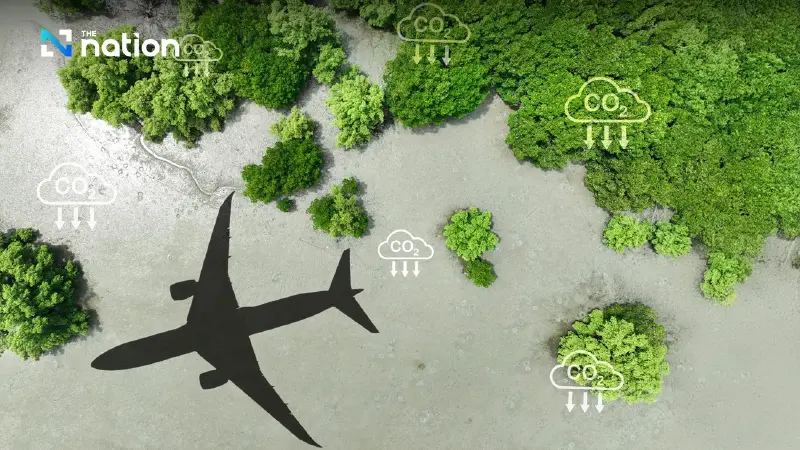


Thailand's carbon credit standards are now recognised globally, allowing airlines to use credits to offset emissions.
- Thailand has joined the International Civil Aviation Organisation's (ICAO) global carbon offset scheme, known as CORSIA, after its domestic greenhouse gas reduction programme was officially recognised.
- This allows airlines operating international routes to purchase carbon credits from certified Thai projects to offset their emissions during the scheme's first phase (2024–2026).
- Eleven types of projects are eligible to generate these credits, including renewable energy generation, forest planting, and waste management initiatives.
- The move is expected to create a significant domestic market, with five Thai airlines forecasting a combined demand for over 400,000 tonnes of carbon credits.
The International Civil Aviation Organisation (ICAO) aims to promote the use of sustainable aviation fuels (SAF) to reduce greenhouse gas emissions in the aviation sector. The key goal is to achieve net-zero carbon emissions by 2050.
At the 42nd ICAO Assembly, held on October 3 in Montreal, Canada, representatives from 193 member countries reiterated the push for international aviation to cut carbon dioxide emissions by 5% by 2030, as part of the broader net zero target.
However, despite global policy frameworks on SAF, most of the production comes from China. As China itself increases its SAF consumption, this limits the supply available to the global market.
This situation is creating intense competition, prompting several airlines to look beyond SAF, turning to carbon credits to offset their emissions.
Thailand joins global aviation carbon offset plan
Nakorn Tangavirapat, Executive Director of Thailand Greenhouse Gas Management Organisation (TGO), stated that ICAO’s recognition of Thailand’s voluntary greenhouse gas reduction programme, under the Premium T-VER standard, allows airlines serving international routes to use carbon credits to offset their emissions.
This initiative falls under the Carbon Offsetting and Reduction Scheme for International Aviation (CORSIA) Phase 1 (2024–2026).
The programme requires that projects be creditable from January 1, 2016, and that emissions reductions occur between January 1, 2021, and December 31, 2026. Project developers must obtain authorisation from the Department of Climate Change and Environment to use carbon credits for international purposes.
Thailand will report on the use of these credits in its Biennial Transparency Report (BTR) to ensure transparency and accountability to the global community.

11 certified projects achieve carbon credit standards
A total of 11 project types are eligible to participate in CORSIA, including:
- Renewable energy electricity generation for grid supply
- Renewable energy electricity generation for self-use or direct sale
- Electricity and thermal energy cogeneration from biomass for dispatch
- Conversion of internal combustion vehicles to electric vehicles
- Community waste management to replace landfill disposal
- Methane capture from anaerobic wastewater treatment for use or flaring
- Forest planting (excluding wetlands)
- Mangrove planting
- Mangrove and seagrass restoration
- Forest management improvements
- Sustainable agricultural land management
The International Air Transport Association (IATA) estimates that carbon credit demand for CORSIA Phase 1 will reach between 146 and 236 million tons of CO2 equivalent (MtCO2eq) over the three-year period.
Currently, the only market-ready project is Guyana’s REDD+ (Reducing Emissions from Deforestation and Forest Degradation) programme, offering 4.64 MtCO2eq, with additional projects from biomass (1.5 MtCO2eq) and cookstoves (0.18 MtCO2eq) entering the market.
The limited supply is struggling to meet growing demand, creating a supply-demand imbalance.
Airlines look to buy carbon credits domestically
According to futures trading data from the Intercontinental Exchange (ICE), carbon credits are priced between US$15 and US$21 per ton of CO2 equivalent (USD/tCO2eq).
In July 2024, the Thai airline association discussed with TGO the carbon credit purchasing plans for CORSIA Phase 1. Five member airlines operating in Thailand forecast a combined demand of over 400,000 tCO2eq over three years.
This presents an opportunity for Thailand, as the purchase of Premium T-VER credits could prevent the outflow of US$6 million to US$8.4 million (roughly 192 million–268.8 million baht) from the country.
