
Earthquakes around Thailand as Myanmar and Indonesia keep shaking
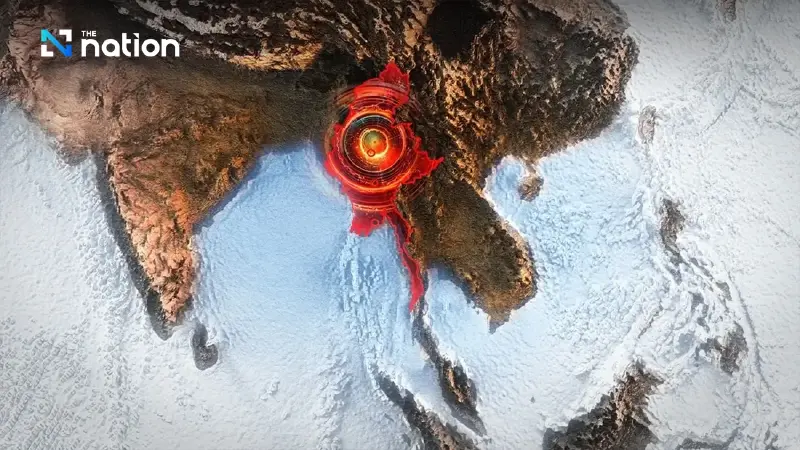


Tectonic activity around Thailand remains under close watch, with frequent quakes in Myanmar and Indonesia and small tremors in northern Thailand.
- Frequent earthquakes are occurring in Myanmar near Thailand's northern border, with recent tremors (magnitudes 5.3 and 3.7) strong enough to be felt in northern Thailand.
- A series of moderate offshore earthquakes (magnitudes 4.9-5.4) have been recorded near Indonesia's Sumatra island, but they have not directly impacted Thailand due to their distance.
- In addition to neighboring activity, small domestic tremors have also been detected within Thailand itself, including a recent magnitude 2.8 earthquake in Phayao province.
Tectonic activity around Thailand remains under close watch, with frequent tremors recorded in neighbouring countries.
Myanmar has seen repeated quakes close to Thailand’s northern border, while Indonesia has experienced several moderate offshore earthquakes near Sumatra. Small tremors have also been detected in northern Thailand.
Tectonic activity around Thailand (early December 2025)
Recent data from the Earthquake Observation Division show that fault lines in areas surrounding Thailand remain active, with three key zones requiring close monitoring:
1. Epicentres in Myanmar (near the Thai border)
High frequency: Myanmar continues to be the most active source of earthquakes in the region, with frequent tremors recorded.
Close proximity: Several recent quakes have had epicentres only about 360–370 kilometres from Pang Mapha district in Mae Hong Son province.
Recent magnitudes:There were earthquakes of magnitude 5.3 on December 10 and 3.7 on December 11, strong enough for people in some parts of northern Thailand to feel the shaking.
2. Off the coast of Indonesia (Andaman side)
Moderate intensity: A series of moderate earthquakes, above magnitude 4.5, have been recorded around the Sumatra islands and Aceh province.
No impact on Thailand: Although magnitudes of 4.9–5.4 were detected on December 9–10, the epicentres were more than 500 kilometres from Thailand’s southern coastline (Phuket and Satun). They have not had a direct impact on Thailand and pose no tsunami risk.
3. Domestic tremors (Phayao province)
Movement on local faults: Thailand has also recorded small but noteworthy earthquakes on its own active faults.
Latest event: On December 10, an earthquake of magnitude 2.8 was reported in Chiang Kham district, Phayao province. Although not strong, residents said they felt the tremor and heard a loud noise.
What frequent tremors tell us
The increased number of small to moderate earthquakes around Thailand indicates ongoing movement of the Earth’s crust and the release of accumulated stress along fault lines. Key points to understand include:
1. Energy release along the Sagaing Fault (Myanmar)
Tectonic setting: The Sagaing Fault in Myanmar is an active fault that is continually moving.
Meaning: Frequent earthquakes in Myanmar, typically between magnitude 3.0 and 5.5, reflect a process in which the Earth’s crust is gradually releasing stored energy along the fault to restore geological balance.
Significance: These smaller, regular releases of energy may help reduce the build-up of stress that could otherwise lead to a very large earthquake in future – although they do not guarantee that a major quake will not occur.
2. Confirmation of an active subduction zone (Indonesia)
Tectonic setting: Off the coast of Sumatra lies a major subduction zone, where one tectonic plate is being forced beneath another.
Meaning: Moderate earthquakes (around magnitude 5.0) in this area are normal behaviour for regions within the Pacific “Ring of Fire” and confirm that the geological structures there remain highly active.
3. Active faults inside Thailand (Phayao and the North)
Tectonic setting: Several active faults pass through northern Thailand, including the Phayao Fault.
Meaning: Small domestic earthquakes, such as the magnitude 2.8 event in Phayao, indicate that these faults still retain energy and are moving slowly, even if the tremors are minor.
Although most of the recent activity has occurred in neighbouring countries and has not directly affected people’s daily lives in Thailand, it serves as a reminder that the region is tectonically active.
It underlines the need for agencies such as the Thai Meteorological Department and the Department of Mineral Resources to continue closely monitoring fault movements and to strengthen preparedness measures for any potential larger earthquakes in the future.
