
Chulalongkorn Researchers Upcycle ‘Ghost Nets’ into High-Tech 3D Printing Material


Dr Nuttapol Risangud leads an innovative project to convert marine plastic waste into industrial-grade filaments, supporting Thailand's green economy
- Researchers at Chulalongkorn University have developed a technology to recycle abandoned fishing nets, or "ghost nets," into high-quality, industrial-grade filaments for 3D printing.
- The upcycling involves a four-stage process: cleaning the nets, grinding them into flakes, compounding them with additives, and extruding the material into standard 1.75mm filaments.
- This high-tech material is being targeted for industrial applications, specifically for creating lightweight, high-strength components for the automotive industry.
- The project aims to create a circular economy that reduces marine pollution while providing a sustainable revenue source for local fishing communities who collect and pre-process the nets.
Dr Nuttapol Risangud leads an innovative project to convert marine plastic waste into industrial-grade filaments, supporting Thailand's green economy.
Researchers at Chulalongkorn University have developed a pioneering technology to recycle abandoned fishing nets, known as “ghost nets”, into high-quality filaments for 3D printing.
The project, led by Dr Nuttapol Risangud of the Petroleum and Petrochemical College, aims to address the critical environmental threat posed by marine plastic while creating a sustainable revenue stream for local fishing communities.
Combating Marine Pollution
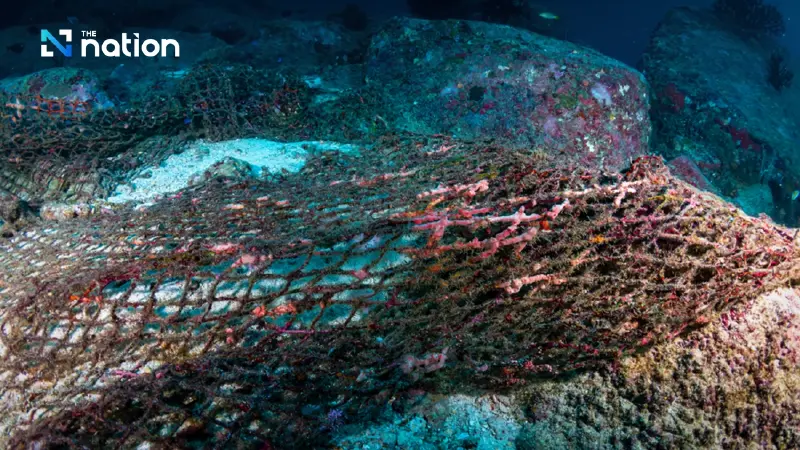
Ghost nets are a significant hazard to marine life, often trapping animals and eventually breaking down into microplastics that contaminate the human food chain.

Supported by the Centre of Excellence on Petrochemical and Materials Technology (PETROMAT) and Ube Technical Center (Asia) Ltd, this research transforms these hazardous materials into precision engineering supplies.
“While basic recycling of nets exists, we are pushing this material into high-tech applications,” said Dr Nuttapol. “By creating a market for 3D printing filaments, we increase the value of waste, incentivising the removal of nets from our oceans.”

The Circular Process
The transformation involves a rigorous four-stage industrial process:
Cleaning: Removal of lead, organic debris, and salt.
Grinding: Shredding nets into uniform plastic flakes.
Compounding: Melting the flakes with specialised additives to create high-standard recycled pellets.
Extrusion: Re-melting the pellets into 1.75mm filaments, compatible with standard Fused Deposition Modelling (FDM) printers.


Industrial Application and the Future
The research team is currently targeting the automotive industry, specifically focusing on lightweight, high-strength components for motorcycles.
The project is structured into three phases: perfecting the chemical formula, scaling production via private sector partnerships, and finally, transferring processing knowledge to coastal communities.
This "Circular Economy" model ensures that fishermen can earn more by pre-processing nets before sale, while providing industries with eco-certified materials.
“This is more than a laboratory experiment,” Dr Nuttapol concluded. “It is a sustainable system designed to benefit the environment, the economy, and the community simultaneously.”
