
Protecting the car from flood waters


Play
I pity owners of vehicles that have fallen victim to the current flooding.
Apart from having to spend money to repair their homes and replace furniture, they also have to replace electrical appliances that could not be moved in time.
Most of these people have rather new homes, and are still paying for them. They have not set aside extra money for home repairs, especially due to the floods.
However, this is not the first time that we have been hit by a severe flood. Thailand is an agricultural country that is located on a plain, fed by over 10 rivers. So, during the end of the rainy season, flooding is a problem that Thais have been facing regularly.
Deforestation has also played a critical role in magnifying the flood problem each year.
But the reason the floods this time have caused more damage that those before is because this is not a flood that slowly arose from the river like before. This time, the floods happened because of the collapsing of the dykes, leading to flash floods in many areas, including homes and factories. It happened so fast that people had no time to move their belongings or machinery, hence the damage is estimated to be very high.
Automobiles were damaged by the floods so quickly that owners didn’t have time to drive them to safety. The water level rose quickly and the amount of water was gargantuan. We see vehicles being carried away by the water and crashing into walls or homes, causing damage to the body. This is something different from the past when the damage was simply because the vehicle was submerged.
So, those who live in risky areas and are unable to remove their vehicles should know how to tackle the situation in case the dykes break down.
First, if you are able to lift the car to a higher level, do so. When you use the jack to slowly lift the car, make sure that the objects you place underneath are strong enough. Cement blocks and bricks may appear strong, but they can crack easily so you should not use them. If you can get wood boards that are wider than the vehicle’s tyre, then you can stack several of them together.
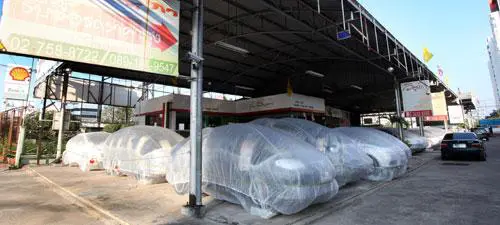
During this flood, there have been many new techniques for saving cars, such as making use of the car cover. The cover is placed flat on the floor and the car is driven over it. Then the edges are pulled up and tied, and if the cover is made of water-resistant material, then you got yourself a pretty convincing protection.
There are also large plastic bags which are sold for Bt3,000 and have become very popular. You simply drive your car into this large bag, come out and then tighten the ends.
However, these two techniques are useful only if the water rises slowly. If there is a strong current, the vehicle may be carried away and it may hit walls or trees. You can increase the weight of the car easily by putting stacks of old magazines or newspaper into the trunk and cabin. Pile on as much as you can so that it would be more difficult for the current to move the vehicles from its original position.
For those who are pretty sure they will not be able to evacuate from the flooded area in time and risk high-level flooding (and do not have the large bags to protect the car), try the following suggestions:
First inflate the tyre as much as you can. Then fill in engine oil until it overflows from the top, and do the same with the brake fluid. Get some grease and apply it on the engine oil and transmission fluid measuring stick in order to seal the gaps. If you can’t get any grease, then use plastic foodwrap in order to prevent water from entering the engine or transmission.
Spray a little anti-moisture spray (Zonax) on all electrical connections, then coat them with grease or wrap them up tightly with plastic film. Give special attention to the ECU (Electronic Control Unit), and wrap it up many times until you are sure no water can enter. Seal the opening of the air inlet with a plastic bag and tighten it properly. Do the same with the exhaust pipe. If you can’t find small plastic bags then condoms can also do the job
For the interior, remove the rubber mat and seal the plastic-covered areas and ventilation holes with grease or silicone. Do the same with other ventilation holes and gaps around in the cabin.
Finally, remove the battery terminals and remove the battery (actually you can also leave the battery as it is).
These tips will help you minimise the damage that the flood waters could cause to your vehicle. However, once the water level drops, do not attempt to start the engine right away. First make sure that you have got rid of all water and moisture from the electrical system.
