
Dedicated testing centre sorely needed


Play
Top auto industry experts agree project needs to be revived for
During the past two-three years, the Thai automobile industry has been in a rather “risky” situation due to negative factors such as turbulent national politics, fluctuating oil prices and, worse, the mega flood crisis in late 2011.
It has been estimated by the Automotive Industry Group of the Federation of Thai Industries that the massive flood had cost Thailand production of 300,000 vehicles worth Bt300 billion last year due to government mismanagement as well as various uncontrollable factors.
Prime Minister Yingluck Shina-watra’s visit to Japan last month as well as other road shows to that country are expected to help Thailand not only convince investors to maintain their presence in the country but also make further investments.
The Thai delegation met with auto execs from Toyota, Suzuki, Isuzu and Nissan, all of which have production bases in the Kingdom. But the main question that is being asked is whether Thailand will lose out in becoming the “Detroit of Asia” due to the various crises bombarding the country.
Thailand needs official test,
R&D centre, JAMA says
With as much as 70-80 per cent of total investment in the Thai auto industry being made by Japanese companies, the Japan Automobile Manufacturers Association (JAMA) is keeping an eye on developments here.
JAMA director Shinichiro Oka told The Nation that Thailand has the capability to produce 3 million vehicles per year. He said production of this number of vehicles could be achieved in the next three years if nothing goes wrong, and went on to add that the country could reach the 4-million-vehicle mark if there
is continuous government support and clear mechanisms and policies.
“The 3-million-vehicle target is not a distant number. As far as we know, European and American auto-makers have already announced expansion plans here, while others are also planning to make land investment in Thailand. Considering various factors, Thailand is the most attractive country to invest in in this region, whether we look at the supplier base, the level of skilled labour or the long auto-promotion policy by the government,” he said.
However, in order to be competitive globally, Thailand should build its own test centre as well as an R&D centre, which will dramatically help strengthen the foundation of the Thai auto industry, especially the suppliers, who will be able to catch up with the latest technologies, Oka advised.
“It will also help lower production costs and make it easier for people to own cars with good quality,” he said.
“As far as we know, Thailand already has a testing centre in Bangpoo, which belongs to the Industry Ministry, and many companies have set up their own R&D centres. However, that may not be adequate if Thailand wants to grow further,” he said, adding that the Thai government and the private sector would need to finalise an agreement in setting up an official testing centre.
Oka also said that free-trade agreements made by Thailand with other countries, including Japan, has helped accelerate growth in the auto sector for the whole region.
The entry of Myanmar into the Asean community is also a positive sign.
Although it is just starting out, Myanmar has future potential, while the development of the Indonesian automobile industry is also something that JAMA gives importance to. We believe that if the details are formulated well enough to create a perfect Asean Economic Community, the capability of Asean as a single market will also be increased, he said.
centre must be up and
running ‘in five years’
Suparat Sirisuwannangkura, president of the Automotive Industry Group as well as senior vice president at Toyota Motor Asia-Pacific Engineering and Manufacturing, said that if Thailand wants to maintain its “Detroit of Asia” status, it should not overlook the need for official testing and R&D centres.
“However, due to the present situation, it may require a longer period of time. We discussed the matter recently with parts manufacturers,” he said.
According to Suparat, Thailand’s initial production target last year was 1.8 million vehicles, which was not realised due to the 2011 flood.
“In November the industry’s capacity dropped to just 23,000 units, despite the fact that we had to produce 170,000 vehicles that month. November turned out to be a month with the lowest production, but the situation started to improve in December, with production of about 90,000 units. Then it became clear that we would not be able to achieve our target and finished the year with only 1.45 million vehicles,” Suparat pointed out.
The value of lost production amounts close to Bt300 billion (considering that each vehicle costs Bt1 million), he added.
Auto-makers are presently close to achieving normal production, with total production in January reaching 140,000 vehicles – 50 per cent of which were exported. However, suppliers located in the seven major industrial estates that were flooded last year have recovered by only 40 per cent.
This has forced auto-makers to use foreign suppliers as a replacement but production costs have dramatically increased as a result, Suparat revealed.
He said Thailand celebrated production of 1 million vehicles in 2005, but the target of 2 million in 2010 could not be achieved.
“Thailand cannot afford to be careless because there are many negative factors, both controllable and uncontrollable. Right now automobile companies are unable to do much due to the recovery process, while parent companies are investing in production in order to clear up the 200,000-vehicle demand. But the testing centre is necessary and it should be set up in five years, when total auto production in Thailand is expected to reach 3-3.5 million vehicles,” he said, adding that the centre could cost Bt3-4 billion.
“It is necessary that the private sector joins hands in the investment; the sector could bear 20-50 per cent of the investment cost,” he said.
Suparat added that apart from the testing centre, the government needs to have clear and transparent automotive policies.
“If there are changes too often, especially in terms of tax issues, market growth could be affected and this will, in turn, affect the production sector. Investors from Japan, the US, Europe and India all agree that the Thai government must be clear and have a long-term policy that will not change later. Various ministries must also go in the same direction, unlike today when people speak about ethanol, CNG or biodiesel. There is nothing that is sure despite having a 20-year energy plan,” he said.
These negative factors could result in lower foreign investment, as auto companies spread investment to other countries in order to minimise risks.
Parts makers wait in hope
Thai Autoparts Manufacturer Association (TAPMA) president Achana Limpaitoon said TAPMA is preparing to urge the government to bring back the testing centre project, in order to raise the capability of Thai auto parts makers and prepare for an increase in automobile production.
TAPMA is presently discussing the matter with those concerned, including the Thai Automotive Institute (TAI), since its small-to-medium parts makers lack testing facilities unlike larger auto-makers and parts makers that have their own testing facilities.
She said that if Thailand wants to become the “Detroit of Asia” it needs to have a testing centre. According to her, initial investment would have to be in the region of Bt10 billion.
Achana said she is preparing to submit a proposal to the government on behalf of TAPMA by the end of the year.
“With Thailand serving as a production centre for automobiles, the parts-manufacturing sector must also adapt to new developments. The problem is that parts makers have to send finished products to Japan for testing, but this is time-consuming as well as costly. Meanwhile, the testing centre at Bangpoo doesn’t have the capacity to carry out all the testing, and setting up a new [larger] testing centre would help parts manufacturers to develop along with the industry,” she pointed out.
Legend of the centre
The automotive testing and R&D centre is a project that has been talked about many times, starting in 2002.
The initial plan was to build the centre on a 200-rai plot of land. The construction was planned for 2005 and was to be completed by 2006, while testing was to commence in 2008.
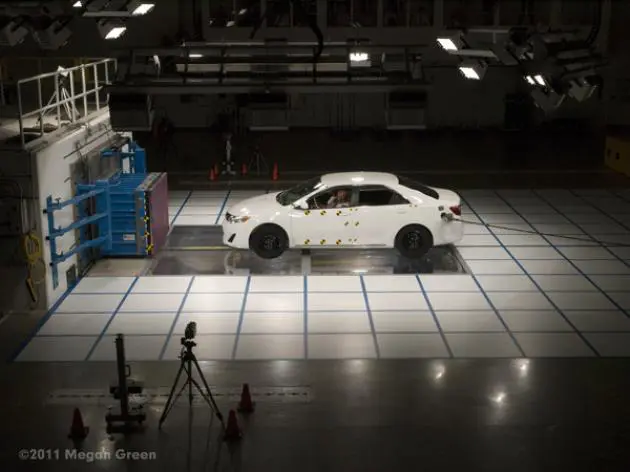
The testing centre would be responsible for standard testing such as emissions, lighting equipment, braking, crash tests and engine performance. There would also be five special test operation rooms.
The main building to carry out the testing was expected then to cost Bt1.6 billion, and initially three main locations were considered – Ayutthaya, Samut Prakarn and Chon Buri.
At the time, the industry minister decided that the government would fund the project, since it would play a major role in the development of the “Detroit of Asia”. Four organisations – TAI, TAPMA, the Auto Parts Industry Club and the Automotive Industry Group – jointly donated Bt1 million to carry out a feasibility study for the project.
Several locations were proposed by the private sector including the Amata Group and Prachin Eamlumnow, the organiser of the annual Bangkok International Motor Show. But the project slowly disappeared after government and private sectors were unable to agree to the details and size of investment.
After Suparat became president of the Automotive Industry Group in 2010, he brought the project back on the table, but once again it was overshadowed by major disruptions faced by the industry due to natural disasters last year.
Nevertheless, as the industry recovers, the setting up of the national automotive testing centre will help the country’s automobile industry maintain its competitiveness in the global marketplace.
