
Cisco Global Cloud Index forecasts cloud traffic to grow sixfold by 2016


Play
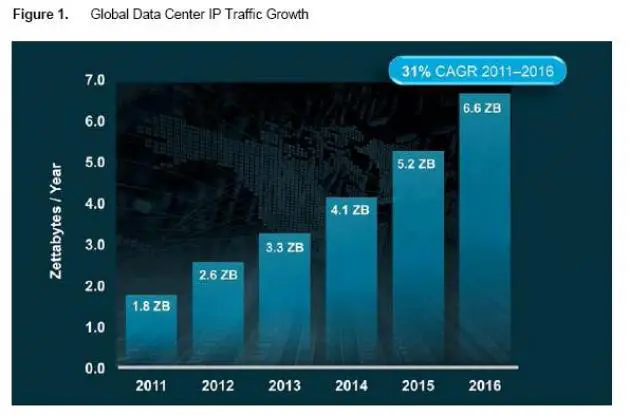
Cisco forecasts global data center traffic to grow fourfold and reach a total of 6.6 zettabytes annually by 2016.
The forecast was made in the second annual Cisco Global Cloud Index (2011-2016) issued Monday.
The company also predicts global cloud traffic, the fastest-growing component of data center traffic, to grow sixfold – a 44 percent combined annual growth rate (CAGR) – from 683 exabytes of annual traffic in 2011 to 4.3 zettabytes by 2016.
To give a picture how vast the data would be , Cisco explains that 6.6 zettabytes is equivalent to 92 trillion hours of streaming music or equivalent to about 1.5 years of continuous music streaming for the world's population in 2016.
The 6.6 zettabytes is also equivalent to 16 trillion hours of business Web conferencing or equivalent to about 12 hours of daily Web conferencing for the world's workforce in 2016.
The 6.6 zettabytes is also equivalent to 7 trillion hours of online high-definition (HD) video streaming or equivalent to about 2.5 hours of daily streamed HD video for the world's population in 2016.
The vast majority of the data center traffic is not caused by end users but by data centers and cloud-computing workloads used in activities that are virtually invisible to individuals, Cisco said.
For the period 2011-2016, Cisco forecasts that roughly 76 percent of data center traffic will stay within the data center and will be largely generated by storage, production and development data. An additional 7 percent of data center traffic will be generated between data centers, primarily driven by data replication and software/system updates. The remaining 17 percent of data center traffic will be fueled by end users accessing clouds for Web surfing, emailing and video streaming.
From a regional perspective, the Cisco Global Cloud Index predicts that through 2016, the Middle East and Africa will have the highest cloud traffic growth rate, while the Asia Pacific region will process the most cloud workloads, followed by North America.
