
Affordability is key in smart-phone market


Play
Local, foreign brands target low and medium-level users in 3G era
The smart-phone market in Thailand is dominated by affordable devices, with more brands entering the fray and most of them targeting the low- to medium-level segment.
Satianporn Suvansupa, associate market analyst, Client Devices, at IDC Thailand, said the Thai smart-phone market this year is expected to hit 9.02 million units, which would represent 70-per-cent annual growth. The market is expected to continue growing – at 25 per cent – next year.
This is similar to a prediction by research firm Canalys, which forecasts the market will grow to 10 million units this year, due in large part to mobile networks being upgraded from 2G to 3G.
Smart-phone sales have expanded into the mass market, with many launches targeted at low- and medium-level users, the company said.
Meanwhile, research company GfK said the smart-phone market in Thailand was worth about Bt40 billion last year. It is expected to grow by around 37 per cent this year to Bt54 billion.
This huge growth has attracted many brands to jump into the market, making it highly competitive.
Huawei has returned to the market in the expectation of gaining a 5-per-cent share in the next three years. In terms of revenue, it expects double-digit growth, partly due to the take-off of 3G service in the Kingdom.
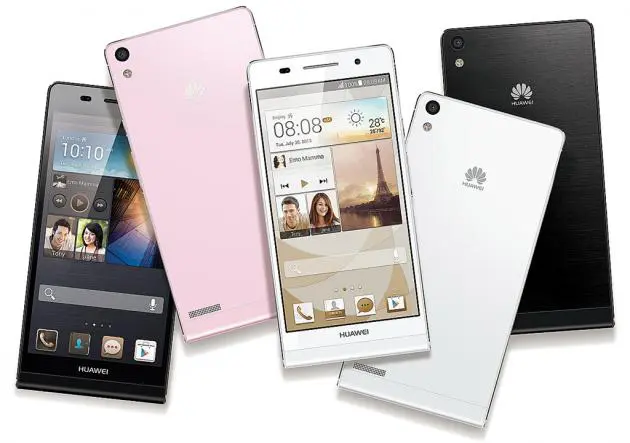
The Ascend P6 is the Chinese maker’s flagship product for this year, and is targeted to reach 2 million unit sales in Asia, said Thomas Liu, Huawei Device managing director for Southeast Asia.
“We are ranked globally No 4, and No 3 in China,” he said.
He added that Thailand is the third-largest smart-phone market in Southeast Asia, after Indonesia and the Philippines, with almost 3 million units sold this year.
It is a more open market than most in the region, he said, adding that Huawei is one of the main phone providers in the competitive Android market.
“We want to support our clients the best. This is a good time for the telecom industry, and it is very challenging. We continue to see opportunities for our consumer business and it is important for us to continue to provide the best product at the right price,” said Liu.
Huawei plans to launch more than 10 models of lower-level products in Thailand, with screen sizes of between 3.5 and 6.3 inches. Prices will be in the range of Bt3,000 to Bt13,990, to attract more customers upcountry, said the MD.
Moreover, the company will spend US$2.5 million (Bt78.1 million) on marketing to promote Huawei products in the Kingdom this year, and will open its first flagship store by year-end in Siam Paragon.
“Compared with our competitors, Huawei smart phones lack branding but the Ascend P6 holds a pricing advantage and advanced technology. We are confident that the exceptional build quality of the Ascend P6 will help Huawei gain a foothold alongside the industry’s biggest names,” said Liu.
“In the past, our businesses were B2B [business to business] oriented and we worked closely with operators. Today, the open market presents other opportunities and we are doing B2B and B2C [business to consumer] business at the same time.
“We will focus on creating our brand awareness with a relevant promotion and advertising campaign across the globe. We believe that in three years’ time, the Huawei brand will be as well-known as the other smart-phone makers,” said Liu.
Thai operators join growth market
Both True Move H and DTAC (Total Access Communication) recently also launched their own-brand smart phones – the True Beyond family and the DTAC TriNet Phone range – in order to attract 2G mobile-phone users to their 3G networks.
Prapaprot Puprasert, DTAC’s senior vice president, Device Management and Business Operation Division, said the recent launch of 3G on the 2100MHz band had brought a tremendous increase in communication service capacity to Thailand.
3G handsets with a 2100MHz band compatibility currently account for only 20 per cent of the market, representing a huge growth opportunity, he said.
“Since our network is in full readiness and the market growth prospects are clearly visible, it’s a perfect moment for the DTAC TriNet Phone to offer a new option for Thai consumers,” he added.
The devices, which have been developed by DTAC in partnership with Huawei, are available in three models – the Cheetah, Joey and Mousey – all featuring combined 2G-1800MHz, 3G-850MHz and 3G-2.1GHz modes, for Bt4,590, Bt2,590 and Bt1,290, respectively, including value-added tax.
DTAC is targeting that about 20 per cent of the company’s sales of smart phones will be DTAC TriNet devices, he said, adding, “In Thailand’s competitive smart-phone market, our strength is that we offer 15 months after-sales service and support at our service centres throughout the nation.”
DTAC allocated a budget of Bt100million for the launch of the TriNet Phone, with a comprehensive marketing strategy comprising advertising in both mainstream and online media as well as other promotional activities across Thailand.
Prior to DTAC’s launch, True Corp had already introduced three True-branded smart-phone and tablet devices in the Beyond family.
With the appointment of leading girl group Girls Generation, from South Korea, as the new brand ambassador, True is aiming to raise its brand image to the global level.
The company is spending about Bt50 million on the marketing campaign for the three devices: the True Beyond Tab tablet, priced at Bt4,990; the True Beyond smart phone, priced at Bt6,590; and the 4G/3G-enabled True Beyond 4G smart phone, priced at Bt9,990.
It hopes to achieve early sales of 100,000 units of the three devices.
PC-makers back in the market
Moreover, the huge growth of the smart-phone market in Thailand has also attracted leading computer-makers to start launching their own devices again, with Asus, Acer and Lenovo all ready to renew battle in this competitive market.
Milko van Duijl, president for Asia-Pacific and senior vice president, Lenovo Group, said the smart-phone market represented a tremendous opportunity, and one in which the Chinese company could grow aggressively – with Thailand being one of the priority emerging markets in Asia for Lenovo.
The company believes there are three key factors for the success of smart phones – product, brand and local channel – he said.
In Thailand, Lenovo has two major distributors: Ingram Micro, focusing on the telecommunication channel, and ECS, which concentrates on the IT channel.
With the company having released six new models at the local launch of its smart phones in May, Lenovo has an aggressive plan to gain a double-digit share in the Thai market, he said.
Mark Chu, country product manager of ASUSTeK Computer (Thailand), said Asus this year was focused on both smart phones and tablets, due to the high growth in both markets.
The Taiwanese maker will be introducing more models to the market, he said.
Meanwhile, Acer – another leading Taiwanese brand – recently launched the new 3G Acer Liquid Z3 smart phone in Thailand.
Acer Computer’s senior marketing manager, Nitipat Praweenwong-wuthi, said the upgrade from 2G to 3G in Thailand had prompted feature-phone users to seek to change their handsets to smart phones with capabilities matching their lifestyle, and retailing for a good price.
Mobile-phone users demand access to the Internet so that they can work, chat and share information conveniently anywhere and anytime while on the go, he said.
Acer launched the Liquid Z3 with cooperation from AIS (Advanced Info Service), and the device is exclusively available from AIS outlets.
The Liquid Z3 – an Android-based smart phone that comes with Dual SIM capability – retails for Bt2,590.
Vendors ready to do battle
Nokia last week introduced the Lumia 625, in collaboration with DTAC and the launch of an operator billing service that gives the option of safe and convenient application purchases for Windows Phone users.
Samarn Takort, head of Technical Sales, Nokia (Thailand), said the local unit of the Finnish maker continued to introduce new services by launching the billing service.
The service will strengthen Thailand’s mobile communications industry, as it provides safe and convenient payments via the operator’s billing system, which will encourage more app downloads and generate more income for app developers, resulting in the sustainable growth of Thai developers as a whole, he said.
Japan’s Sony, meanwhile, expects 37-per-cent growth in the Thai smart-phone market due to positive factors, such as the 3G service launches by the Kingdom’s three main operators, and especially the expansion from HSPA (high-speed packet access) to 4G LTE (long-term evolution) smart phones.
Sony is the first brand to cooperate in the 4G LTE campaign with True Corp, said Krit Prapatsakdi, head of sales and marketing at Sony Thai.
“We do have more Thai consumers who are starting to switch from feature phones to smart phones. We expect smart phones to be one of the key markets that will drive our business in Thailand,” said Krit.
Sony’s market direction is to position itself as the premium alternative to Samsung and Apple, since mobile products such as smart phones and tablets are a strong focus for the company.
The key strategy is to combine the best of Sony with premium smart-phone specifications in order to create a true smart-phone experience, he said.
Sony will focus on expanding relationships with key operators, leveraging the Sony brand in both established and emerging channels and collaborating with Sony stores in Thailand at the retail level, he added.
“We will introduce at least six models in the second half of the year and, as you might know, we will have another flagship model which will be launched in Thailand very soon,” said Krit.
Meanwhile, LG Electronics (Thailand) has strengthened its smart-phone technology leadership by introducing the flagship Optimus G Pro to the Thai market.
The South Korean maker this year aims to have a market share of 10 per cent of all Android-based smart phones in Thailand.
In the first half, LG achieved a 7-per-cent share with sales of 100,000 units. It aims to sell a further 250,000 units in the second part of the year, said Sivakorn Damrongphatr, marketing manager for Mobile Communication at LG Electronics (Thailand).
