
Attrage eco-car aims to attract older buyers


Play
Though this Mitsubishi sedan may leave a few things to be desired, it looks more mature than its Mirage predecessor, is comfortable when cruising and suitable for a longer road trip, while the top model comes packed with features
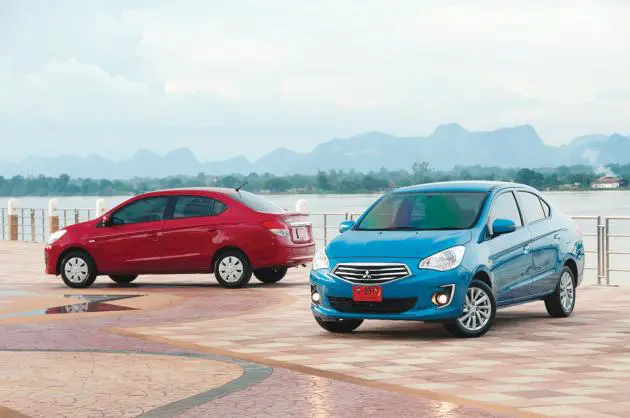
Mitsubishi has hit the road to quick success with its Mirage eco-car – over 100,000 of which have been sold. And with its foot firmly on the accelerator, the automaker has now introduced a derivative of the Mirage hatchback. Called the Attrage, it offers a sedan choice for customers who prefer this type of body.
Mitsubishi is one the five Japanese car companies that took part in Thailand’s eco-car project, and one of the requirements was that by the fifth year, annual production of each brand’s eco-car has to reach 100,000 units annually. So introducing a second variant can also be seen as a move to help achieve that production figure.
While the Mirage is a compact eco-car aimed at the younger generation, the Attrage, despite sharing the same fundamentals as the hatchback, is a car that can help draw in older customers with its sedan body.
While the Mirage appears to be on the “cute” side with suitable dimensions for driving (and easy parking) in the city, the Attrage looks decidedly more mature and comfortable, suitable for a longer road trip.
I was offered the GLS Ltd trim (priced at Bt582,000) for a few days and was surprised with many of the features that came with it. Well, the highlight in the top Attrage model has got to be the newly developed navigation system with a touch-screen monitor, along with a rearview camera system for backing up. Considering that the Attrage is targeted at new drivers, these features actually make life much easier for them. Mitsubishi has also thrown in automatic climate control, audio controls on the steering wheel and a smart combination stalk that blinks the turning lights three times if you tap it slightly, which is perfect for changing lanes on the highway while keeping both hands on the steering wheel. Plus there’s a liberal amount of storage space, including a number of cup and bottle holders. The only things missing are automatic headlights/windshield wipers, but considering the market segment of the Attrage, I don’t blame the company for not offering them.
The centre air vents look rather narrow and funny, but work just fine, and at the sides you get nice circular ones. The cooling performance is great – I had to raise the temperature many times as the cabin got pretty cold with the sun playing hide and seek. There is good headroom in front, but this is just an economy car so don’t expect a cabin that is too wide. At the rear there is just enough headroom for six-foot-tall passengers, but ample legroom makes up for it.
The Attrage is powered by the same 1.2-litre 3-cylinder motor that propels the Mirage. It develops 78 horsepower and 100Nm. As I mentioned, this is an eco-car and the main priority here is fuel economy, not performance. Mitsubishi claims the Mirage can run 22 kilometres on a litre of fuel, a figure which is among the best in its class, but go through the official specifications and you won’t find this figure stated there. It is actually displayed on the first page of the brochure, quoting combined UNECE standards. However, in real-life driving, it’s hard to achieve that figure. I averaged 10-18 kmpl in city/highway driving, and I wasn’t pushing the car either – just accelerating smoothly and keeping my speed under 100 kmph. Nevertheless, there’s an “Eco” light on the dash that serves as a guide, letting you know when you are driving economically. You’ll of course need to follow it for the lowest fuel consumption, but you may soon get tired of it since it forces you to accelerate much slower than usual when driving in heavy traffic. Apart from this, it works fine, lighting up while cruising or accelerating smoothly at higher speeds.
The engine is quite noisy, but there’s nothing to complain about concerning the CVT (continuously variable transmission) as it does its job well. A ladder-type gate also looks good and features an “S” button for sporty driving.
Despite being impressed with many features offered, what I didn’t like about the Attrage is the steering and the suspension. Sure, the steering wheel looks and feels nice in your hands, but it’s light and lacks feedback, taking more revolutions at the wheel to get the desired steering effect. The good point of this seems to be the narrow turning circle, a class-leading 9.6 metres. The strut/torsion suspension, on the other hand, offers acceptable ride comfort when cruising. But start changing lanes quickly and you will certainly realise how wobbly it is. There is also a large amount of noise when travelling over bumps and potholes, a common result of extreme cost-cutting.
Now you may get the inkling that I don’t fancy the Attrage, which I can assure you is not the case. In fact, Mitsubishi has done a good job if you consider the pricing and the fact that this car is targeted at buyers who aren’t driving enthusiasts. The design is pretty nice and there are enough gadgets to attract potential buyers in the eco-car segment who are first-time car owners.
The Attrage starts at Bt443,000 for the GLX version with manual gearbox and rises to Bt477,000 for the GLX CVT, Bt530,000 for the GLS CVT and Bt582,000 for the GLS Ltd.
Mitsubishi Attrage GLS Ltd
Engine: 3-cylinder DOHC 12 valve MIVEC
Displacement: 1,193cc
Bore and stroke: 75x90mm
Compression ratio: 10.5:1
Max power: 78ps/6,000rpm
Max torque: 100Nm/4,000rpm
Transmission: CVT
Ratios: 4.007-0.550
Suspension (f/r): McPherson strut, coil springs, stabiliser/torsion beam
Steering: Electrically powered rack-and-pinion
Turning circle: 9.6 metres
Brakes (f/r): vented discs/drums
Dimensions (mm)
Length: 4,245
Width: 1,670
Height: 1,515
Wheelbase: 2,550
Track (f/r): 1,445/1,430
Weight: 930kg
Wheels: 15-inch alloy
Tyres: 185/55R15
Fuel tank capacity: 42 litres
Price: Bt582,000
Distributor: Mitsubishi Motors Thailand
