
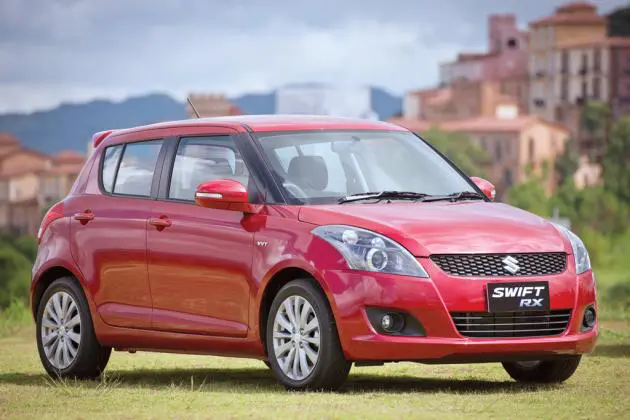
Swift RX gets a bit of style


Play
Suzuki's new hatchback eco car offers good ride quality and driveability in city traffic, but don't expect much passing power on the highway
The money-spinning eco car market is about to witness accelerated competition with the introduction of the second phase of the programme that allows both old and new manufacturers to churn out even more attractive models.
The first model in the Eco Car Phase 2 programme will be the award-winning Mazda2 that’s set to be formally launched early next year. And although this car’s price range may be considerably higher than eco cars on sale now, it rings a warning bell for other automakers to quickly shift into higher gear.
Suzuki was one of the first marques to offer a car under the first eco car project. The Swift five-door hatchback quickly gained cult status, witnessing more orders than Suzuki’s plant could supply. Due to the high popularity, buyers had to wait months to take delivery on their cars.
Unlike several other eco cars that are cute small cars for the city – like the Nissan March, Honda Brio, Mitsubishi Mirage and Suzuki’s own Celerio – the Swift boasts a larger body.
It is actually a B-segment car but can take advantage of eco-car privileges because it can fulfil all the requirements – fuel economy of 20 kilometres per litre, CO2 emissions of 120 grams per kilometre and Euro crash standards.
Toyota’s Yaris, which was the last model to be sold under Phase 1, also fits the criteria, and now, the Mazda2 is set to take on the competition. It’s a matter of engine downsizing.
The Swift is powered by a 1.2-litre, four-cylinder engine capable of producing 91 horsepower and 118Nm, which is basically what you would get from that displacement. The engine is mated to a fuel-saving continuously variable transmission (CVT).
With the competition heating up, Suzuki has decided to offer a new flagship model for its Swift range, which had been available with five trim levels at prices ranging from Bt434,000-Bt564,000.
The new Swift RX gets additional equipment upgrades and although final pricing has not been released, Suzuki executives say they will try to “keep it under Bt600,000” at the grand launch during the Thailand International Motor Expo later this month.
The main upgrades in the Swift RX include paddle shifters, cruise control and new headlights, making the price increase pretty acceptable for what you get.
I did not get to test drive the Swift when it was first launched, and later tried out only the manual version introduced as a support model. The reason was that the CVT, despite its high efficiency, lacked the sportiness to match the car’s rather good steering and suspension.
But I finally got to drive the automatic version of the Swift, which now comes with paddle shifters that add some pizzazz to the drive.
Starting from Suzuki’s head office in Bangkok, I drove the Swift RX up to Khao Yai for lunch and back as my two passengers preferred to stay off the wheel and have a nice chat instead.
The Swift is easy to drive in city traffic and the 1.2-litre engine is economical, but you can’t expect much overtaking power on the highway, with the 118Nm of torque doing the best it can to get you to the desired speed during that kickdown.
Right now I’m thinking that a peppy 1.5-litre or 1.6-litre would be perfect for the Swift, but that’s not going to happen because of the eco-car privileges, otherwise it would be in a totally different price neighbourhood.
The car’s steering and suspension are fine though, offering good precision and ride quality, along with better high-speed stability than many other eco cars on the market. Brakes are vented discs up front and drums at the rear with an anti-lock braking system and electronic brake distribution.
The interior is clean looking yet comes with a bit of style. Along with the paddle shifters, the leather-wrapped steering wheel also houses controls for the audio system and cruise control (I wonder how many people actually use this thing without falling asleep).
There’s a sleek storage compartment on the passenger side console, but the space between the front seats is narrow and there’s not enough space if both of you have a large cup of iced coffee, mobile phone and cigarettes.
There is smart entry with a push-start button and automatic climate control, but the windshield wipers and headlights aren’t automatic and the audio system doesn’t come with Bluetooth. At least there’s a USB slot right down the centre console next to the 12-volt socket.
Although there are several things that I’d love to see in the Swift RX that would make it an even more attractive hatchback, there is actually so much that can be offered while trying to minimise the price increase.
Suzuki Swift RX
Engine: four-cylinder, 16-valve with VVT, Displacement: 1,242cc, Bore and stroke: 73.0x74.2mm, Compression ratio: 11.0:1, Max power: 91ps/6,000rpm, Max torque: 118Nm/4,800rpm, Transmission: CVT, Ratios: 4.008-0.550, Suspension (f/r): McPherson strut/torsion beam, Steering: powered rack-and-pinion, Turning circle: 10.4 metres, Brakes (f/r): vented disc/drum
Dimensions (mm) Length: 3,850, Width: 1,695, Height: 1,510, Wheelbase: 2,430, Track (f/r): 1,480/1,485
Weight: 975kg, Wheels: 16-in alloys, Tyres: 185/55 R16, Fuel tank capacity: 42l, Price: n/a, Distributor: Suzuki Motor (Thailand)
