
School in Korat pioneers Google Apps for Education


Play
Students, teachers make learning fun and productive in "smart classrooms"
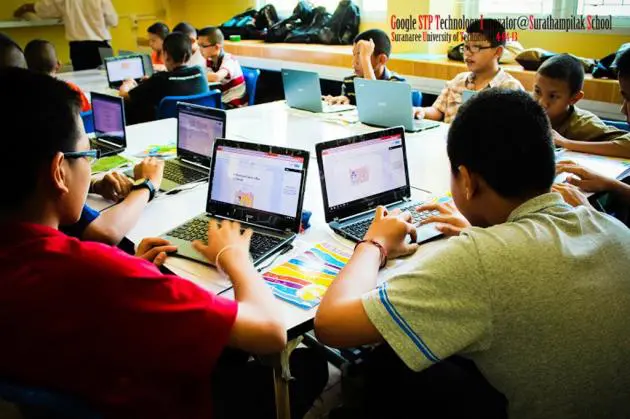
Students at Surathampitak School, an elementary school in Nakhon Ratchasima province, have been enjoying a “smart classroom” environment powered by the Google Apps for Education initiative.
The school, which is well equipped with Internet infrastructure and adopted Google Apps for Education a year and a half ago, is a showcase for the adoption of best-practice technology in the education sector.
Sawan Duangmanee, a computer teacher at the school, said Surathampitak had been implementing Google Apps for Education for three semesters, since January 2013. Students in each grade, from Matthayom 1 to Matthayom 6, can learn at least one subject per semester with Google Apps.
“We are pioneering the Google Apps for Education initiative. Our teachers were trained to use Google Apps for teaching. The school has also received support from Google, such as technical consultation and some Internet connections,” he said.
The system shifts the learning format from chalk and blackboard to computer and Internet.
“All teachers have their own Google Site, which serves as the personal website of each teacher containing course outlines and details that enable students to undertake self-learning anywhere at any time via any device,” Sawan said.
Students enjoy learning by connecting to the Internet. They access their teacher’s Google Site to learn about the course subject. They exercise assignments through sharing via the teacher’s Google Drive. Students can do their exercises and submit them to the teacher by sharing their files on Google Drive.
“We can utilise the time spent in the class more productively. They [pupils] spend time together doing the assignments closely watched by the teachers, and all of these activities are online.
“With the Google Apps, teachers can set the access authentication to check class attendance, participate in group or individual assignments, and submit homework electronically.” Sawan said this made it possible to tailor their interaction with the students to match their individual needs.
He said the beauty of Google Apps for Education was that everything – e-mail, documents, calendars, and websites – was automatically saved in the cloud and could be accessed as well as edited on almost any mobile device or tablet at any time and any place.
Therefore, a stable Internet connection is essential, he said. The school has four links to high-speed Internet (totalling more than 200 megabits per second) covering all six buildings and outdoor space, which totals 38 rai (6 hectares).
“Teachers can check students’ class attendance via their smartphones, even in physical-education class. Teachers and students can use computers, tablets or smartphones to log on to the Internet for the class anywhere throughout the school.”
The whole process of learning with Google Apps is done electronically without having to carry around bulky exercise sheets. This kind of learning motivates students by making learning fun. They enjoy participating in the classroom, since Google Apps allows them to collaborate in real time with friends and share their work with teachers instantly. They concentrate more in the class and are more active in doing their lessons.
“As a result, their school records are getting better. Their parents are also happy that their children have less homework, since they have already completed it in class,” Sawan said.
As exercises are assigned and done electronically on Google Apps, the school saves a lot of money because it no longer needs to buy a lot of paper for coursework, exercises, quizzes and examinations.
Currently, about 30 teachers are using Google Apps as a teaching tool, while more than 2,000 pupils from Matthayom 1 to Matthayon 6 learn with Google Apps once a semester. Surathampitak School is taking the next step to expand the use of Google Apps to more teachers and classes, aiming to be a role model for other schools in Nakhon Ratchasima province.
