
UTCC sets its sights on 'Apple Distinguished School' status


Play
Business university fully embracing US giant's technology to provide flexible, student-focused approach to both its teaching and learning
THE University of the Thai Chamber of Commerce aims to be designated an “Apple Distinguished School”, having already become the first university in Thailand to adopt iTunes U in its learning platform – and being ranked ninth worldwide in terms of universities driving traffic to iTunes U.
UTCC president Asssociate Professor Sauwanee Thairungroj said the institution had fully deployed iTunes U in the learning platform over the past semester, after providing all of its 18,000 students with an iPad as a crucial learning tool over the last four years.
The university is the first in Thailand to adopt Apple iTunes U in classes.
The learning and teaching environment has dramatically changed as a result, as students are no longer limited in their learning by time and space, she said.
Given the digital environment and change in student behaviour, driven by technology, the university started to flip the traditional classroom focus around with the launch of a strategy called ‘hybrid university’ – putting students firmly at the centre of learning and teaching, while teachers play the role of facilitator.
“We realised that technology could enhance learning and teaching and help us to move from the crisis of learning in a boring traditional environment into an active and engaging learning environment, so we decided to provide all teachers and students with a device as a learning and teaching tool in their hands,” said Sauwanee.
Ten years ago, the UTCC started by giving each of its teachers and students a computer notebook, followed by a more manageable netbook, and then four years ago an iPad.
“All our teachers and students use an iPad in class every day. We needed to better utilise our learning and teaching performance, so we invited Apple Inc’s vice president for education to visit us. We asked Apple for help in enhancing our capability to use the company’s technologies in education, and found that Apple iTunes U was the right answer to what we were looking for,” said Sauwanee.
The university has now trained 500 teachers in the concept of ‘flipping’ the classroom, as well as in the use of innovative technologies.
All teachers are encouraged to use these technologies in class and to develop courseware in any content medium, be it text, audio, video or the e-book format.
“We have established an ‘ICT excellence centre’ with 20 teachers and staff to work as a technology support team to provide help for all teachers and staff members,” said the UTCC president.
The initiative has already turned 400 subjects into Apple’s iBook format, and the university aims to have 700 UTCC-created iBook contents available on iTunes U by the year’s end.
“We will turn all of them into
the iBook format by the end of
this year. Additionally, the university is also putting its other content in any format, such as the business game show on TV called ‘Family Business’, on iTunes U,” said Sauwanee.
The university has already turned its existing electronic books into iBook content via iTunes U to allow students to download and run through the classes – as well as another 800,000 iBooks available at the campus – at any time.
The institution is ranked ninth worldwide in terms of universities driving traffic to iTunes U, she added.
Moreover, Sauwanee said the UTCC had set a goal to become an Apple Distinguished School, which is a certification granted by the US tech giant for outstanding schools in terms of innovation, leadership and educational excellence.
Pointing out that no Asian university has yet received this certification, she said that in order to become an Apple Distinguished School, the UTCC needed to pass in terms of best practice in five areas: visionary; innovative learning and teaching; ongoing professional learning; compelling evidence of success; and flexible learning environment.
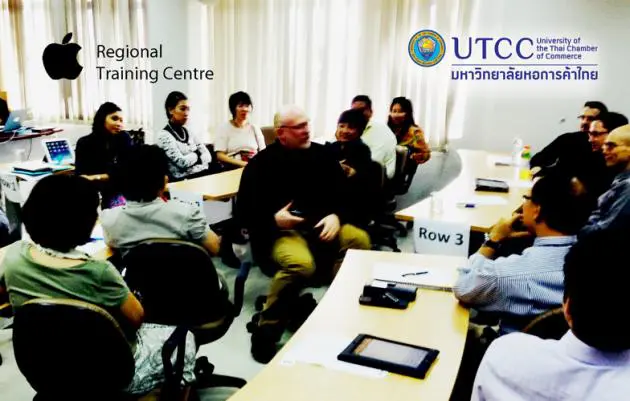
Meanwhile, the university is also the Apple Regional Training Centre for Southeast Asia, the centre having been set up and run by UTCC since early this year.
The university also has six teachers and staff members training to be certified Apple Professional Development specialists, whose role is in turn to train the institution’s 500 teachers in how to integrate Apple products into the curriculum, she explained.
Urban campus
The university has also created a flexible environment by offering free Wi-Fi throughout the 40-rai (6.4 hectares) campus to facilitate students to enjoy learning via their iPads anywhere within the grounds.
The whole area is also set to be developed under the ‘urban campus’ concept to serve the flexible learning environment even further.
Under this concept, it will better utilise the 40-rai space by constructing buildings three times higher than at present, as well as making them smart and intelligent, said the president.
The campus development programme will run through 2019 at a total cost of Bt4 billion, up to Bt1.5 billion of which will be allocated to information technology.
Under the IT budget, it will lay down the backbone hi-speed Internet for all buildings at 10 gigabits per second. Buildings are currently linked with hi-speed Internet at 3Gbps, double the previous 1.5Gbps after deploying iTunes U early this year.
Normally, the university has Bt200 million as an annual IT budget, largely for providing students with iPads and upgrading the Wi-Fi network throughout the campus.
Some 350 Wi-Fi hotspots have been installed, a number that is set to rise fourfold when the new-landscape campus is launched.
“With the technology-embedded environment, we can train students in digital literacy along with the acquisition of business knowledge. Our goal is to get our students
ready for the digital economy, and to perform well in their working and other lives. This forms part of the university’s mission to be the leading business school in Asia,” said Sauwanee.
