
Cisco banks on Intercloud as it looks to 'build tomorrow today'


Play
Strongly promotes need for reliable "Internet of clouds" as giant seeks to capitalise on potentially huge market for the Internet of Everything
US tech giant Cisco is betting big on its grand plan to build the Intercloud – a global network of cloud systems – in order to wrestle for a larger market share of the largely untapped Internet of Everything (IoE) market, which is predicted to be worth US$19 trillion (Bt640 trillion) in the next 10 years.
Its senior executives participating in the annual conference and trade show “Cisco Live 2015” in San Diego last week promoted the idea of the Intercloud heavily.
They pointed to the need for a secure and reliable “Internet of clouds” to cope with the exponential adoption of digital devices worldwide.
Cisco’s outgoing CEO John Chambers, in his keynote speech at the event’s opening ceremony, said that we are at a time when everything from wearable device to vehicle, and from home to country becomes digital.
“It will become a digital world that will change our life, our health, our education, our business models,” he told the audience.
This year’s event, held at the San Diego Convention Centre between June 7 and 11, was participated in by some 26,000 people, including Cisco’s business partners, program developers and customers, in addition to members of the media from around the world.
The theme of “Cisco Live 2015” was “Let’s Build Tomorrow Today”.
About 18 months ago, Cisco unveiled an ambitious plan to create the Intercloud ecosystem that will unify smaller cloud service providers into a competitive system, offering products that are all compatible with each other.
At the San Diego event, the company announced that it was now significantly expanding its Intercloud ecosystem with the addition of 30 global partners and a $1-billion investment from Cisco Capital to boost adoption of Cisco-powered clouds.
It also announced partnerships with several software developers, in addition to the launch of Intercloud Marketplace and Intercloud Fabric.
The former is an online app store for its customers to get started with the tools, technologies and software they need to quickly make use of their cloud, while the latter is a new technology for controlling and managing data centres and the Intercloud all at once.
Cisco’s share in the IoE market – which is dominated by other US tech giants like Google, Amazon and Microsoft – is only 5 per cent and there is still a vast part of the market that remains untapped, according to Peder Ulander, Cisco’s vice president of cloud services.
Chris White, Cisco’s senior vice president for global IoE/IoT solutions sales, said that although between 12 billion and 15 billion devices were already connected to the Internet, 99 per cent of “things” on the planet were still not.
But, he added, the rate of connectivity is exponential, with
some predictions saying as many
as 200 billion devices will be connected to the Internet in the near future. This represents a vast opportunity.
In the evolving world of IoE – which is the next evolutionary stage of the Internet of Things (IoT) –electronic devices of different platforms “work together” in connected environments, through sensors, wireless links and the Internet.
Data are collected and transferred to the cloud before being analysed to extract real-world insights that can benefit businesses, authorities and consumers in many areas, including healthcare, retail and government services.
Broad-based IoE potential
White said IoE technology could be applied in many areas of industry, such as manufacturing and energy, in order to help save costs and boost efficiency.
The IoE concept has been adopted in many projects Cisco collaborates in with government agencies and its business partners.
These include a “smart city” project in Kansas City that, when it commences operations next year, will allow residents to enjoy a more responsive and efficient city in the way it provides lighting, manages traffic flow, offers parking and maintains roads.
There is also a project with the San Diego Metropolitan Transit System to provide more accurate notification of next-train arrival time for waiting passengers.
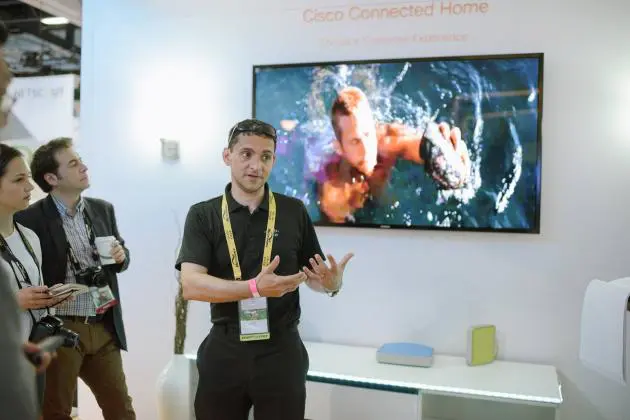
The World of Solutions area of this year’s Cisco Live event displayed many of such Cisco-powered projects that complement its concept of “the connected life”. These included the “connected home” solution that allows home electronic appliances such as televisions to be programmed so that the content meets the preferences of individual residents.
There were also solutions of “connected learning” for distant education, “connected factory floor” for manufacturing plants, and “connected transportation” for mass transit.
