
Microsoft introduces project to spark innovation among creative Thai youths


Play
Microsoft (Thailand) is helping young entrepreneurs become more innovative with a project aimed at enhancing their information and communication technology skills.
The project is part of a collaborative approach that aims to give them the skills to successfully run small and medium-sized enterprises.
YouthSpark – Enhancing ICT for Youth SMEs in Thailand – is now in its third year. It is a partnership between Microsoft and the Population and Community Development Association and the Thailand Research Centre of Communication and Development Knowledge Management.
It targets entrepreneurs aged 18 to 24 by equipping them with e-commerce and e-business skills as well as the benefits of technology in business.
Microsoft’s YouthSpark is a global initiative committed to helping young people worldwide create and seize opportunities.
This year in Thailand, a Bt2 million grant will be used to implement ICT skills training sessions for more than 700 young entrepreneurs.
Since the initiative was established in 2013, it has reached over 48,000 youth in Thailand and resulted in over 120 business weblogs being created for startup businesses.
With an estimated 36 million unemployed youths in Asia and against the backdrop of the full implementation of the Asean Economic Community this year, the initiative has recognised that the need to create more opportunities for youths to enter the workforce has become increasingly crucial.
Research by the World Bank highlighted that 70 per cent of jobs globally are created by SMEs, reinforcing the critical need to foster entrepreneurship among youths.
The training sessions will include coding lessons designed to stimulate creativity, logical problem solving and critical thinking skills among young Thais.
Organised in the form of classroom training, online learning and distance learning held through a virtual presence in a traditional education setting, the training sessions will be held in 12 provinces: Bangkok, Buri Ram, Chiang Mai, Chon Buri, Khon Kean, Krabi, Nakhon Ratchasima, Nakhon Sawan, Nakhon Si Thammarat, Phetchaburi, Phichit and Prachuap Khiri Khan.
Somsak Mukdavannakorn, public sector director for Microsoft (Thailand), said that as Thailand accelerated towards a digital economy, young entrepreneurs needed to enhance their competitiveness through the use of ICT in their businesses.
He said they needed to apply e-commerce and e-business skills to reach a global audience, and be able to seize opportunities in a hyper-connected, mobile world.
“Through our partnership with PDA and CCDKM, the Microsoft YouthSpark initiative will empower young Thai entrepreneurs by providing the tools, resources and facilities necessary to realise new opportunities of employability and entrepreneurship,” said Somsak.
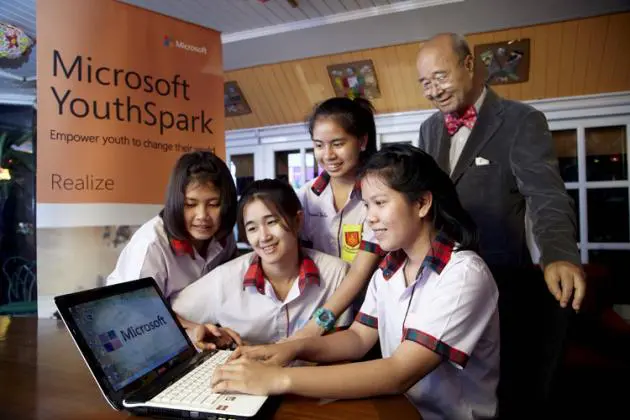
In addition to the training sessions, the PDA’s Mechai Pattana School in Buri Ram will also receive 26 laptops to enhance students’ learning experiences and equip them with technology skills relevant in today’s digital age.
Mechai Viravaidya, PDA chairman, said that the Mechai Pattana School’s vision is to create an environment where students from poor, rural communities can fulfil their potential through creativity skills, new ideas and current technology.
Under Microsoft’s YouthSpark initiative, the tools, resources and facilities made available to these students will help them secure a viable future, improve their quality of life and in the long run, eradicate poverty.
Kamolrat Intaratat, chair of the Asia Pacific Telecentre Network (APTN) and director of CCDKM, said that CCDKM is committed to bridging the digital divide and utilising the advantage of ICT to create a positive social and economic impact amongst marginalised communities in Thailand.
“In the three years that the initiative has been running, it has been seen how local youth have benefited from the ICT training and resources in order to be more productive and relevant to compete in Asean,” said Kamolrat.
