
On the crest of a growth wave, Skyscanner searches for Thai start-up


Play
Thailand's most updated English news website, newspaper english, breaking news : The Nation
After significant growth this year, global travel search engine Skyscanner says it is committed to penetrating the Thai market.
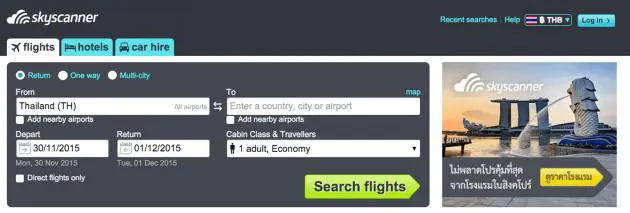
Skyscanner offers an unbiased, comprehensive and free flight search service as well as instant comparisons for hotels and car hire.
Since the launching of www.skyscanner.co.th in 2011, the company has seen exceptional expansion. As of October 2015, its revenue experienced 79.6 per cent growth, its average monthly visitor growth was 57.7 per cent and its average mobile unique monthly visitors (including apps) saw 74 per cent growth.
Li’er Wong, senior business development manager, Asia Pacific, said Thailand was an important market for the company.
The company’s strategy emphasises local traditions, knowledge, culture and trends. In its APAC hub in Singapore, it has hired teams with intimate local knowledge to help with localisation. More importantly, it fast-tracked the process by seeking out local partners in each market – including Thailand – to provide users with international and domestic travel options in order to continually expand global distribution and reach.
“We are keen to continue engaging with the developer community via our travel API and White Label programme so they may create localised travel solutions for the Thai market,” said Wong.
She said, even though Skyscanner is a global company, its culture and mind-set is that of a start-up, a company still in an exceptional growth trajectory and planning to sustain it.
“We are competing on a global level – as is the case for every start-up business that is serious about being a success,” said Wong.
The company says one of the key success factors is to be flexible and prepared to change and pivot. As a start-up, Wong said, it needed to learn from others. For example, opening up to developers and start-ups has been the best business decision the company has made to enable innovation in travel.
“Our API solution powers trip planners globally so start-ups such as Rome2Rio could focus on providing an integrated travel experience. Building partnerships is the priority of Skyscanner’s business. We have the most comprehensive flight coverage and work with over 1,200 global partners, including online travel agencies, airlines, hotels and car hire companies,” said Wong.
Unlike online travel agencies, Skyscanner does not sell tickets directly. Wong said the company takes customers directly through to the online travel agency, airline, hotel or car-hire company to book with them.
“Our business model means we’ve been profitable for some years now and we’re able to self-fund our rapid growth,” said Wong.
She added that now it is a very exciting time for the start-up community in Thailand. Having spoken at the Start it Up Conference earlier this month, it was no surprise to him that Thailand was an increasingly popular home to both foreign and home-grown tech start-ups alike.
At the same time, as APAC is one of the most geographically and culturally diverse regions in the world. Thai tech start-ups will need to develop strategies for some markets limited by structural and institutional factors.
Wong says through Skyscanner’s travel API and White Label solutions, Thailand’s start-ups can build a first-class travel search experience, and scale the traditional barriers to entry by not having to develop functionality from scratch, thus allowing them to focus on their own core strengths.
“Our travel APIs connects organisations directly to all the data they need to build an innovative website or app. The organisation’s customers will be able to take advantage of the best deals on flights, hotels or car hire from wherever they are in the world. Our White Label solution is a platform for integrating Skyscanner flight search and car hire into the start-up’s website. “Plug and play.” It is tailored to suit the organisation’s brand identity. All of our partners benefit from our global coverage, extensive experience in the travel industry and proven conversion rates,” said Wong.
