
Epson to focus on innovation for 50% growth


Play
Inkjet printers and visual products, plus smart wearables and advanced robotics are key areas under “Epson 25” mission
Japanese technology giant Epson is focusing its business in four areas, in a strategy that is expected to help increase revenue from an estimated ¥1.1 trillion (Bt376 billion) this year to ¥1.7 trillion in 2025 under its “Epson 25” mission.
The Japanese company will also up the focus on business-to-business (B2B) operations to achieve 50-per-cent growth during the 10-year period, while robotics and smart wearables are seen as high-potential business areas for the near future.
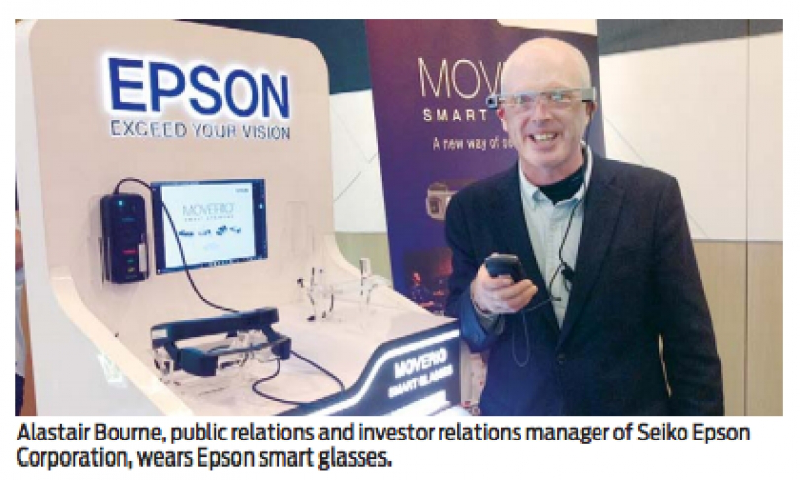
Alastair Bourne, public relations and investor relations manager of Seiko Epson Corp – Epson’s full name – said the four business areas under the corporation’s new business vision were inkjet innovation, visual innovation, wearable innovation and robotics innovation.
In these fields, the company will concentrate on smart technology, environment and energy-saving performance, process innovation and optimisation.
For inkjet innovation, the main focus is on inkjet technology that will deploy smart technology with PaperLab, which is the world’s first dry-process compact in-office paper-recycling system that creates new value for paper.
It is also creating an innovative new office-based recycling culture with high-speed Epson business inkjet machines, he added.
Shuji Hamaguchi, general manager for the professional printing division for Southeast Asia at Epson Singapore, said the company’s business strategy was now to establish outstanding competitive advantage with hardware, improve support and other organisation infrastructure, and achieve solid growth in new domains.
It also provides simple, flexible inkjet manufacturing processes in new business domains, including signage, textiles and labelling to accelerate business and the industry shift to digital, he said.
Ian Cameron, general manager for brand and communication at Seiko Epson, said the company’s main business was still inkjet consumer printers, which accounted for 40-45 per cent of its revenue.
Almost 50 per cent of all receipts worldwide are printed on Epson point-of-sale (POS) printers, he said.
Meanwhile, almost one-third of all business presentations around the world are given on Epson business projectors, while nearly 50 per cent of business printers in the US are inkjet printers – of which almost 30 per cent are Epson machines.
There is therefore huge activity in business inkjet printers both in the US and worldwide, Cameron added.
Bourne said that for visual innovation, Epson remained No1 in projector business – a market in which it was determined to continue to thrive – and would put Epson’s Moverio BT-300 smart glasses on the market in December.
The new smart glasses feature breakthrough silicon-based OLED (organic light-emitting diode) digital-display technology, enabling a truly transparent mobile augmented-reality experience for users in the business and consumer markets, he said.
Under its wearable innovation, the company will also provide a smart wearable device with sensing technology as a fashionable wristband, which will be a new Epson product range in the next few years, he added.
As to robotics, the company already deploys high-precision SCARA robots in manufacturing industry for a wide variety of assembly applications.
However, Epson envisions developing robots to see, sense, think and work like humans, working alongside and supporting humans in a variety of situations.
The firm targets robotics-business growth of 150 per cent for its 2016 fiscal year, driven by strong demand in Southeast Asia, and will provide robots focused largely on the healthcare and hospitality industries.
Ng Ngee Khiang, regional general manager, robotics, at Epson Singapore, said the company was combining core technologies with sensing and smart technologies in manufacturing, expanding applications, and creating a future in which robots supported people in a wide variety of situations.
“We want to create robots [that perform] like humans. In the near future, we will be able to offer robots in areas such as the healthcare, hospitality and services sectors. We have developed many types of sensors and semiconductors, which a lot of our competitors outsource from us. Therefore, we intend to continue to develop this technology to achieve business growth over the next 10 years,” Bourne said.
With more than 55,000 robots installed worldwide, mainly in the manufacturing industry, Epson has also announced a new six-axis industrial robot that delivers high speed and precision in a compact space with maximum flexibility, he said, adding its compact wrists and slim body design provide a wide range of motion for tight spaces.
“The ‘Epson 25’ vision aims to create a new connected age of people, things and information with efficient, compact and precision technologies. We provide the technology direction for the company, and the next step in Epson’s growth as a technology company worldwide.
“Epson will continue to leverage core technologies to create new innovations that will meet new needs across our focus segments, to bring new value to our customers through precision and smart technologies that will reduce the impact on our environment,” the public relations and investor relations manager explained.
The corporation’s growth goal of 50 per cent by 2025 implies a compound annual growth rate of around 4 per cent per year during the period.
B2B revenue currently accounts for around 40-45 per cent of overall income.
Epson spends around 5-6 per cent of total revenue on research and development per annum, mostly on precision core technology for printing business.
Yunyong Muneemongkoltorn, general manager of Epson (Thailand), said the Thai unit would follow the business direction flowing from headquarters, with a focus on the four new business areas, for which there is high market potential in the Kingdom.
Some 60 per cent of the local subsidiary’s income is from inkjet business, he said, adding that the firm is also preparing human resources and marketing channels to support new business and new market segments.
