
Legal view: Can Thailand use force after latest landmine injury?
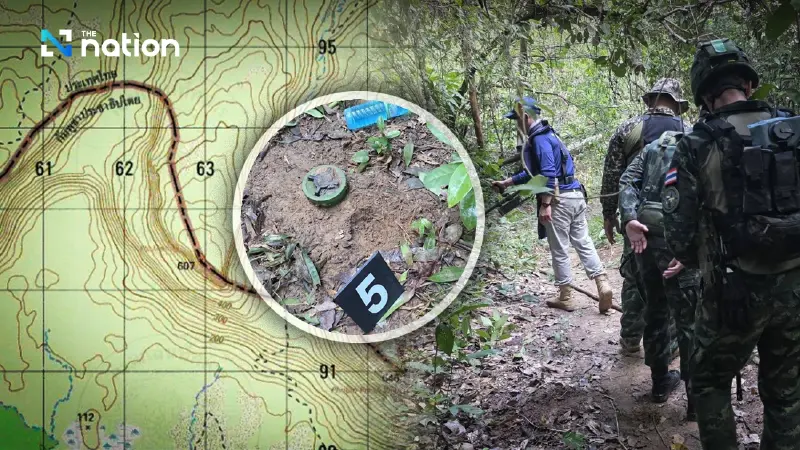


A legal analysis explores whether Thailand has the right under international law to use armed force against Cambodia after a seventh Thai soldier lost his leg to a landmine on Thai soil.
Following the incident on November 10, 2025, in which a Thai soldier lost his leg to an anti-personnel mine while patrolling within Thai territory — the seventh such case — questions have arisen over whether Thailand has the right under international law to respond with armed force against Cambodia, and to what extent.
The following is a legal observation, separate from political considerations, major-power influence, or the wider diplomatic repercussions of an armed response.
Before addressing whether Thailand may legally use force in retaliation, two preliminary points must first be understood:

- On the joint declaration signed on October 26, 2025: The joint declaration signed by the prime ministers of Thailand and Cambodia in Kuala Lumpur, Malaysia, on October 26, 2025, carries no legally binding effect under international law according to the Vienna Convention on the Law of Treaties. It merely represents a shared political commitment.
The declaration is not a ceasefire or peace agreement and thus has no legal force. Any breach of it would only harm the offending nation’s credibility and image in the international political arena, rather than constitute a violation of law.

- On the use of anti-personnel mines: Both Thailand and Cambodia are state parties to the Ottawa Convention banning anti-personnel mines. The use of such weapons therefore constitutes a breach of that treaty and a violation of international law.
However, the Convention lacks direct enforcement mechanisms such as sanctions or military intervention. Violations instead draw diplomatic condemnation, international pressure, and loss of credibility.
Countries found in breach risk reputational damage, reduced international assistance, and suspension of support from global institutions and non-governmental organisations (NGOs) — including funding, equipment, expertise, and technology for mine clearance.
Thailand should continue urging the United Nations and the President of the States Parties to the Ottawa Convention to act decisively within their mandate on this matter.

Can Thailand lawfully use armed force in response?
If it can be clearly proven that the mine was newly laid by Cambodian troops — not an old remnant predating the clashes that began in late July 2025 — the act would constitute an armed attack on Thailand.
This would amount to a violation of Article 51 of the United Nations Charter, granting Thailand the right to exercise self-defence, individually or collectively.
Thailand would then be obliged to immediately report both the attack and its exercise of self-defence to the United Nations Security Council. Any armed response must remain within the bounds of necessity and proportionality, without undermining the Security Council’s authority and responsibility for maintaining international peace and security.
If the previous six cases of Thai soldiers losing their legs were also proven to result from newly planted mines by Cambodian forces, this would further strengthen Thailand’s legal grounds for exercising its right to self-defence.

Conclusion
This analysis is confined strictly to the legal dimension under international law. Should it be proven that the mines were newly planted by Cambodian soldiers, Thailand would possess both the right and legitimacy to use proportionate armed force in self-defence under the United Nations Charter.
Decisions regarding the use of such force, however, ultimately rest with Thailand’s military leadership and relevant state agencies, who must evaluate the necessity and appropriateness of any action. The voices of the Thai people should also be taken into account — all for the sake of national security, the well-being of citizens, and the pursuit of lasting peace.
