
The first ‘Silent Night' remembered


No, not Jesus' birthday - the night the famous Christmas carol was originally performed
WHEN “Silent Night” was born in Austria almost 200 years ago, those hearing it had little idea that the Christmas carol would one day be sung the world over, including this year by Miley Cyrus and a herd of Swedish goats.
This though was the destiny of “Stille Nacht”, premiered to a modest church congregation of ship labourers and their families in the small town of Oberndorf bei Salzburg on Christmas Eve, 1818.
The words, since translated into more than 300 languages and dialects – including Japanese, Welsh and Farsi – had been written as a poem by a priest, Joseph Mohr, in 1816, a time of great suffering in the wake of Europe’s Napoleonic wars.
Two years later Mohr asked his friend stationed in a nearby village, the organist, choirmaster and schoolteacher Franz Xaver Gruber, to compose a tune.
When Gruber duly obliged on December 24, the two men decided to sing it together that very evening at mass in Oberndorf church. The organ was broken, according to legend because of nibbling mice, so Mohr played guitar.
Many years later – in his 1854 “Authentic Account of the Origin of the Christmas Carol ‘Silent Night, Holy Night!’” – Gruber recalled there was “general approval by all”. This approval would snowball, although it is a bit of a mystery how exactly the song then spread.
It is thought that Carl Mauracher, a master organ builder and repairman, played a key role when he took the song home to the Zillertal valley in the Tyrol region. There it was adopted by two travelling singing groups, the Rainer Singers and the Strasser Siblings, who performed around Europe and beyond.
“They were the pop stars of the time,” says Anna Holzner of the Silent Night Museum in Hallein, where Gruber lived until his death in 1863. The museum’s collection includes Mohr’s guitar.
An English version of the German original soon followed and, by the end of the 19th century, it was being sung on all continents, its spread helped by Christian missionaries.
Legend has it that, during World War I, German and British soldiers in opposing trenches sang it at Christmas 1914, its call for peace sounding out over no-man’s land during a famous truce.
Since then the song has been recorded hundreds of times by the likes of Bing Crosby (to huge success) and Elvis Presley, without forgetting John Denver with the Muppets and gravel-voiced satanic German rockers Erloesung.
This year, along with Cyrus’ rendition, comes a new version bleated by goats, released by the Swedish branch of charity |Action Aid – part of an album entitled “All I Want for Christmas is a Goat”.
Today Mohr and Gruber are honoured at a dozen sites locally, including in Oberndorf and in Hochburg-Ach, Gruber’s birthplace, where, for the past 10 years, locals have performed a special play every Christmas.
“In my country this song is sung in 20 or 30 different languages,” says Sally, 45, a bus driver in Salzburg who is originally from Ghana. She’s in the cast performing the song in different languages in the play.
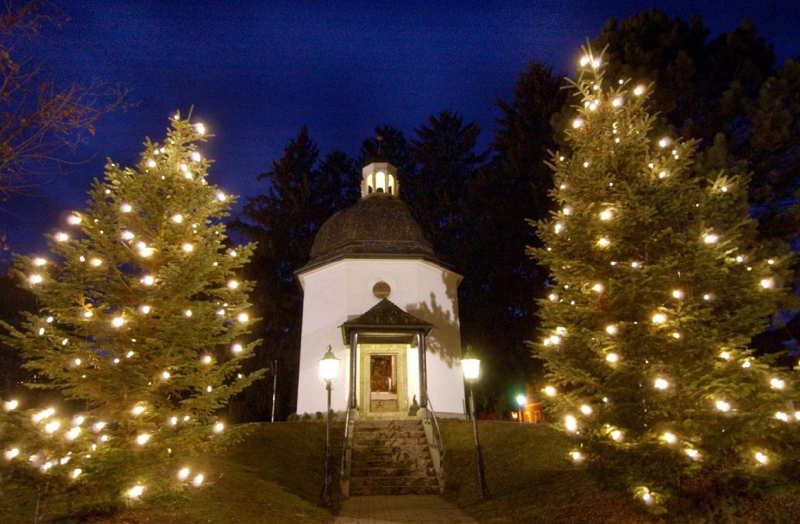
The original Oberndorf church – along with its pesky mice – was demolished at the beginning of the 20th century after being damaged by floods. Today in its place stands a small chapel.
Among stained-glass windows depicting Mohr and Gruber, every December 24 thousands of people gather outside for a Christmas ceremony, including of course a rendition of “Silent Night”.
