
Educating Kachin


Play
A town in Myanmar’s Kachin State just a short distance from the frontline has become a hub of higher learning
HER SMILE is brave if flickering. Fifteen-year-old Maran Lu Lu is struggling to describe how she copes with being a refugee. She grew up in the forested hills of Sin Lum in Myanmar’s northernmost Kachin State, but hasn’t been back in five years. Now she’s sitting in a sparse classroom in the Pa Kahatawng Internally Displaced Persons’ Camp in the area on the Chinese border administered by the Kachin Independence Organisation, the KIO.
“I miss the mountains,” she says in Jingphaw, the Kachin language. “There’s really nothing to do in Ma Jai Yang except go to school – on Sundays my family goes to church and the market – but it doesn’t feel like home.”
Many Jingpo – another name for the ethnic Kachin people – live across the frontier in Yunnan, in relative social and political stability. Lu Lu’s family of 10 has since 2011 lived in cramped conditions in a grid of makeshift housing. The air is fresh, though tinged by cooking smoke, but barbed wire separates the refugees from the rolling cropland that reminds them of the fields they once tended.
Lu Lu’s mother Nhkum Htu Raw has tears in her eyes as she recalls the day the frequent gunfire became ominously louder. “We decided we couldn’t live in Sin Lum any longer,” she says. “We didn’t dare stop to grab a change of clothes.” They left behind their 25 cows, eight buffalo and a motorcycle. “We just started running.”
Some of the family now works occasionally in the fields around the camp, cutting sugarcane for China and being paid in renminbi – 50 yuan a day (Bt271) – to augment their meagre rations and buy more oil, rice and salt for making curry.
The KIO was formed in 1961 when it became clear that the Burmese government was not going to honour promises made when it signed the 1947 Panglong Agreement with the departing British colonialists to safeguard the Kachin and other ethnic minorities. The treaty pledged full autonomy, “in principle” at least. But a 1994 ceasefire pact in which the generals ruling what was now called Myanmar agreed to uphold the spirit of the treaty disintegrated in 2011 when they attacked the KIO’s Kachin Independence Army.
The 17-year peace – really an absence of overt warfare – had seen the continued abuse of Kachin civilians.
Dr Karin Dean, who has closely examined the Kachin predicament, said in a talk at Bangkok’s Asia Centre in February that the peace deal ended up being more of like “surrender” for the Kachin. “Framing this as a ‘conflict’ downplays the violence and suffering – it is a war,” she said. At the same event, a Kachin university student studying in Bangkok said there is “a feeling of peace”, but, “The problem is when the army comes and we have to lock the doors. The Kachin are willing to continue fighting until genuine autonomy is on the table. At this point it is not on the table.”
Jasham Seng Hpung, secretary of the Pa Kahatawng camp, which shelters 3,600 people, says it’s too soon to tell if Aung San Suu Kyi’s new government will bring about change. “Even now, victims of the conflict are still coming to the camp,” he sighs. “I can’t say I’m very optimistic at the moment.”
He says international charitable agencies play a crucial role in aiding the displaced people, particularly the World Food Programme and Karuna Mission Social Solidarity, but “the situation is very difficult” and more help is needed.
A student at the Myanmar Institute of Theology in Yangon, who teaches English at Pa Kahatawng, says the KIO-run camp feels “freer” than the one where she used to volunteer, in the government-controlled Kachin capital, Myikyina.
“The refugees feel safer here in KIO territory. The women in the other camp feel less secure when leaving their homes to go to work because there’s been sexual abuse by the soldiers. That doesn’t happen in Pa Kahatawng.”
And yet there are indeed signs of hope. Mai Jai Yang, which means “beautiful, bountiful fields”, has developed a learning community. The tranquil farming town, where mines have been shut down after poisoning the soil and a massive casino was closed as a threat to local morality, is home to two high schools, a law academy, the Institute of Education and a college that opened last September. Last month saw the First Kachin Scholars’ Association Conference, which drew academics, parliamentarians, journalists and activists from around Myanmar and Singapore, India, China and Thailand. They discussed their research as well as funding possibilities for Kachin teachers, students and displaced people.
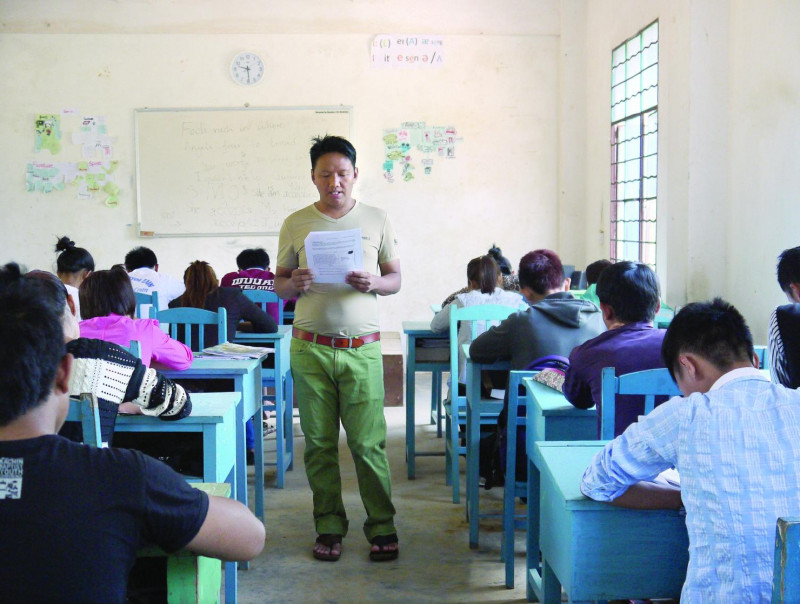
“The association’s main mission will be to reveal to the world the truth about what is happening in Kachin State,” says Nhkum Lazing Zau Seng, who helped plan the conference and is academic director of Mai Jai Yang’s School of Intensive English Programs. More than half of its students come from KIO refugee camps. “This kind of gathering wouldn’t be allowed in Myitkyina,” says Zau Seng, a Kachin himself. “Schools here can teach Kachin history and language, which isn’t allowed in areas administered by the central government.
“In the KIO areas we don’t need to be afraid, but in Myanmar-controlled areas the officials treat us unfairly. If we travel by car they will find something wrong with the car or something inside the car and extort money from us.”
Ten per cent of his students are on scholarships and he’d like to see the figure rise to 30 per cent through international donations, but it’s difficult to secure foreign funding due to political sensitivities and the importance of maintaining good relations with China, which provides crucial links to the KIO-controlled region.
One of the school’s many bright young learners is Zau Hkum, 19, who envisions a Kachin State where he might be a teacher, engineer or guide for foreign tourists. He dreams of prosperity despite a typically harrowing family story of sacrifice and survival. Six years ago he, his sisters, brothers and parents fled their native Japu. The village had become a thriving town during the time of relative peace, and then the army came. “We were afraid the soldiers would harm us, so we went to an area controlled by the KIO.”
It was a 10-hour ordeal through difficult terrain, crossing a river astride felled timber because the KIA had destroyed the bridges to try and stymie the Myanmar troops. In Laiza, the KIO’s administrative capital, they found shelter in the Je Yang camp.
“Being a displaced person made me realise I needed to become educated, for the sake of my family and all Kachin IDPs,” Zau Hkum says. He graduated from high school last year with a scholarship to attend IEP. “I’m learning to communicate better in English and appreciate Kachin history. I’ve learned about the reasons for the civil war – I’d never heard of the Panglong Agreement.”
His classmates hope to serve their community as teachers, soldiers or in tourism, and one boy wants to be a pastor.
Christianity is a hallmark of Kachin cultural identity, brought by British missionaries but blended with animist traditions. The Mai Ja Yang Baptist Church attracts large gatherings on Sundays. There’s also a Catholic church in town and smaller denominations in the area.
Zau Seng says Sin Lum, which means “heartland” in Jingphaw, is special for the Kachin because the first baptisms took place there just over a century ago. “When the Buddhist army took control of the area a few years ago, the Burmese built a pagoda – it was a cultural and religious invasion.”
Heiner Bielefeldt of the United Nations Commission on Human Rights decried such “politicisation of religion for defining national identity” in a talk last October at the Foreign Correspondents’ Club of Thailand. “I’m suspicious of state-imposed harmony,” he said.
Lahpai Nang Bawk teaches English at IEP. Her father joined the KIA and her mother struggled to support the family, but Nang was able to study at Martin Luther Christian University in Assam State on a scholarship from the Euro-Burma Office. “I’m giving my students the chance to lead in the classroom and several of them are outstanding, but it’s difficult finding opportunities and funding for them to study abroad.”
Lahtaw Gum San Awng, IEP’s office administrator, has a similar background – a Shan mother who toiled on a farm after his Kachin father was killed in battle as a KIA soldier when he was just two. He hopes young Kachin will see the state live up to IEP’s catchphrase for Mai Ja Yang, “Land of Wisdom”, but says that, for the immediate future, KIA protection is required.
An hour’s drive takes you to the frontline, where Kachin and Burmese are engaged in trench warfare that’s been compared to the impasse of World War I. On an outcrop of rock surrounded by Myanmar troops, Nhkum Tu Ja, the recently appointed commander of the KIA’s 3rd Brigade, is making his first inspection tour of frontline bunkers protecting Mai Ja Yang.
We’re only about 1,000 metres from a Burmese position, facing an army that “remains strong” regardless of the new civilian government, he says. “They are still creating problems as usual and attacking KIA posts near Myitkyina and Laiza. They don’t really want peace – they want this to escalate this into a full-scale war.”
What the Burmese generals covet in Kachin State are its natural resources – trees, rare-earth elements and the world’s largest jade deposits. “Jade is Myanmar’s big state secret,” Karin Dean said. “It all comes down to jade.” An insatiable Chinese market focuses on the state, and the rights of the indigenous people can be overridden – along with their culture and lives if necessary.
Carleton Cole teaches Asian Studies at Mahidol University International Demonstration School.
