
Khanom Jeen: The “Chinese Snack” That’s uniquely Thai


Thailand’s culinary world is full of surprises, and one of the most intriguing is how some dishes borrow names from other countries yet exist only within Thai borders.
From American Fried Rice to Lod Chong Singapore, these dishes are uniquely Thai despite their global-sounding names. But one of the most beloved and most misunderstood is Khanom Jeen (ขนมจีน), a dish whose name literally translates to “Chinese snack.”

Not Chinese at all
Despite its name, Khanom Jeen is not Chinese. In fact, it doesn’t even resemble Chinese cuisine. The dish is made of soft, fermented rice noodles, often served with a variety of rich, flavourful curries and fresh vegetables. So where does the name come from?
Linguists and food historians believe the term “Khanom Jeen” actually originates from Mon culture, not Chinese. The word is thought to derive from the Mon phrase “khnom jeen,” where “khnom” means to gather in clusters and “jeen” means to cook. This perfectly describes the way these noodles are prepared: neatly coiled into small bundles before being served.

A dish for every region
What makes Khanom Jeen so special is how it transforms across Thailand. In the Central region, you’ll find Khanom Jeen Nam Ya, thin rice noodles bathed in a spicy, coconut-based fish curry, often topped with crispy fried chillies and boiled eggs. In the South, Khanom Jeen Nam Ya Kati Pak Tai gets even bolder, featuring creamy coconut milk, turmeric, and intense spice.


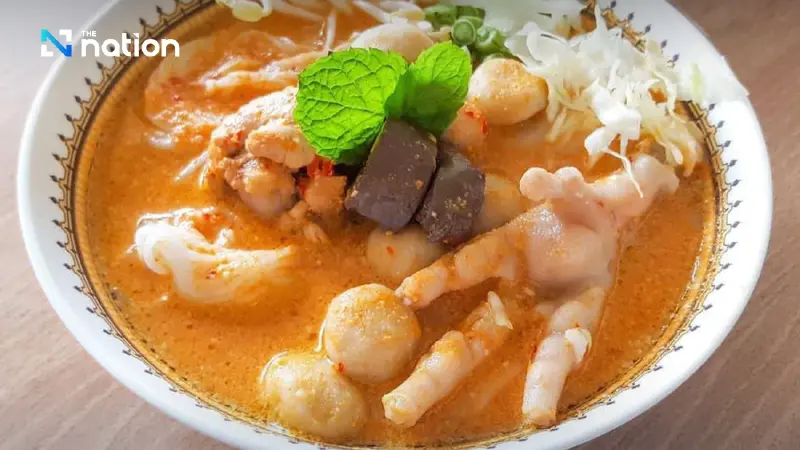
Meanwhile, the Northern version, Khanom Jeen Nam Ngiao, is entirely different, featuring a tomato-rich broth made with pork ribs, dried flowers from the red cotton tree, and cubes of congealed blood, offering a deep, earthy flavour. Each region tells its own story through the sauce, representing local ingredients and traditions.

Khanom Jeen is one of Thailand’s few dishes enjoyed any time of day, whether as a simple breakfast with mild curry or at grand temple fairs and festivals, where locals gather to share large platters. In many communities, especially in the North and Northeast, Khanom Jeen stalls are social hubs where people meet, chat, and enjoy flavours passed down through generations.

From its Mon origins to its Thai reinvention, Khanom Jeen is more than just noodles; it’s a symbol of Thailand’s layered cultural history. Its name may sound foreign, but its soul is unmistakably Thai. Each bite carries centuries of adaptation, blending local ingredients with shared Southeast Asian influences.
