
Chanthaburi-Trat border reopening debate: policy vs military divide?
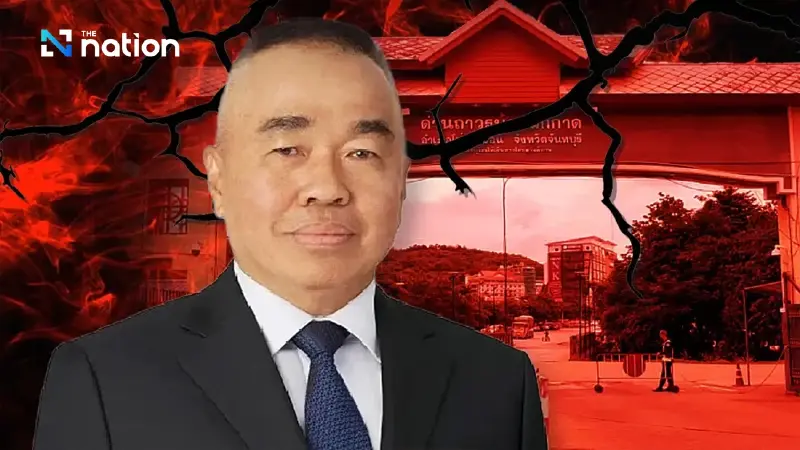


The reopening of border crossings in Chanthaburi and Trat has emerged as a flashpoint following the latest Thailand-Cambodia General Border Committee (GBC) meeting, where the issue was listed among five outcomes.
As reported by Krungthep Turakij, Gen Natthaphon Narkphanit, incoming defence minister, explained that the Defence Ministry has categorised border zones by levels of tension:
- Zone 1 (high tension): Second Army Area (Ubon Ratchathani, Si Sa Ket, Surin, Buri Ram)
- Zone 2 (medium tension): First Army Area (Sa Kaeo)
- Zone 3 (low tension): Chanthaburi and Trat under the Chanthaburi and Trat Border Defence Command (CTBDC)
He said easing measures would start in Zone 3, with the Regional Border Committee (RBC) tasked to define details such as the type of goods, crossing hours and traffic volumes.
Natthaphon stressed that the impetus came from a third country, which prompted Thailand and Cambodia to seek a solution.
Echoing this, Gen Tea Seiha, Cambodia’s deputy prime minister and defence minister, said at a press conference in Koh Kong that one of the five outcomes of the GBC meeting was Japan’s request for the two countries to reopen border checkpoints for the import and export of essential goods.
The statement triggered fierce online criticism, prompting the Defence Ministry’s spokesman to clarify that no reopening had yet been approved and that discussions remained at the principle stage.
At an earlier RBC meeting in late July in CTBDC territory, the Thai side avoided discussing the reopening, focusing instead on demining operations and joint efforts against online scams.
Internally, however, the CTBDC along with the First and Second Army Areas indicated that they would comply with any government directive to reopen, but stressed that priority must be given to settling the more sensitive disputes under the Second Army Area, where Cambodian forces have planted landmines, flown drones and harassed Thai troops.
Ban Nong Chan in Sa Kaeo also remains a flashpoint, with Thai military sources insisting that tensions in the First and Second Army areas must be resolved in concert with the CTBDC and the Second Army before any border crossings are reopened.
During the GBC secretariat talks in Koh Kong from September 7–9, the Cambodian side extended warm hospitality, but Thai officers maintained that reopening could only proceed under conditions: withdrawal of heavy weaponry, verifiable demining, and stricter action against scam syndicates.
Cambodia agreed in principle, but Thai officers privately acknowledged they wished to delay as long as possible, holding the reopening as their only bargaining chip—particularly until Ban Nong Chan is fully restored without relying on the slower Joint Boundary Commission (JBC) process.
Lt Gen Boonsin Padklang, commander of the Second Army Area, echoed this stance, arguing that while the reopening would bolster Cambodia’s economy—heavily reliant on Thai imports of fuel, cement and consumer goods—it could harm Thai soldiers and civilians.
He warned that casinos and scam operations along the border would exploit Thai citizens, leaving many indebted and destitute.
“This is why we need to think carefully,” Boonsin said, questioning whether the reopening would benefit Thailand at all.
The disagreement highlights a widening gap between government policymakers and the military: whether to prioritise economic relief for Cambodia and external requests, or to hold firm until Thailand secures security concessions and disputed territory.
