
From standoff to clashes: Thai-Cambodian border tensions in 2025
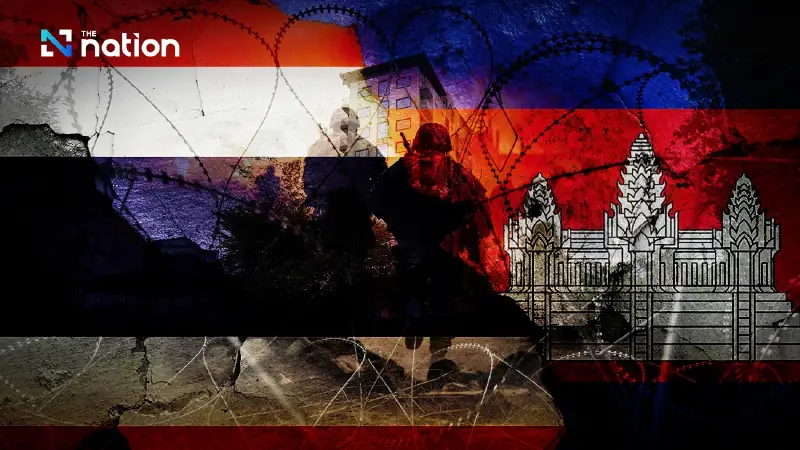


2025 brought unexpected shocks, including Thailand–Cambodia border tensions that disrupted daily life for communities living along the frontier.
- Border tensions escalated in May 2025 after Cambodian soldiers occupied a disputed area, leading to a deadly clash with significant casualties on the Thai side and the capture of 18 Cambodian soldiers.
- International mediation led to the Kuala Lumpur Peace Accord in October, but the peace was short-lived as a second major clash broke out in December, causing further heavy losses and damage to historic sites.
- The year ended with a fragile 72-hour ceasefire brokered on December 27, with future de-escalation dependent on rebuilding trust and addressing issues like prisoner exchange and landmine clearance.
Many people will remember 2025 as a year when the unthinkable happened, and rising tensions along the Thailand–Cambodia border were among the issues that hit local communities hardest.
The issue began escalating following a dispute in specific border areas, notably an incident at the Chong Bok Area in Ubon Ratchathani.
On May 17, images emerged showing Cambodian soldiers encroaching on Hill 745, an area in Nam Yuen district, Ubon Ratchathani. The Cambodian military had constructed a base, dug trenches, and reinforced their positions with nearly 100 soldiers, all armed and ready to confront Thai forces.
Despite military talks that produced an agreement to halt trench-digging and withdraw forces from the disputed area, the first border clash erupted on May 28, when Cambodian forces misread the situation and opened fire on Thai troops.
Cambodia reported that one of its soldiers had been killed in the clash, further escalating nationalistic sentiments on both sides.

The first border clash caused heavy casualties on the Thai side, with Cambodia’s BM-21 multiple rocket launchers reportedly firing sporadically and across a wide area. Seventeen civilians and 18 soldiers were killed, and several others were injured, while rockets were also reported to have damaged homes and public facilities in Thai border communities.
In addition, Thailand also took 18 Cambodian soldiers into custody.
The hostilities continued into late July 2025, culminating in a ceasefire agreement signed by Thailand and Cambodia on July 28, 2025, in Kuala Lumpur, Malaysia, under ASEAN chair Malaysia’s Prime Minister Anwar Ibrahim.
The signing ceremony was attended by representatives from China and the United States, who observed the proceedings as neutral parties.
The border situation reached another milestone after the Thai–Cambodian General Border Committee (GBC) meeting in Malaysia from August 4 to 7. Thailand presented 13 proposals, while Cambodia did not submit its own, instead reviewing Thailand’s proposals and requesting adjustments.
Later, a Kuala Lumpur Peace Accord was signed on October 26, 2025, when the leaders of Thailand and Cambodia concluded a comprehensive agreement at the 47th ASEAN Summit.
The signing ceremony, held shortly after US President Donald Trump arrived in Kuala Lumpur, marked the culmination of international efforts spearheaded by Trump and Anwar Ibrahim.

Thai, Cambodian troops face off again in second border clash
The fragile peace was once again disrupted on November 10 when a seventh Thai soldier lost his leg in a mine explosion near Huai Ta Maria in Si Sa Ket province. This prompted Prime Minister Anutin Charnvirakul to temporarily suspend operations under the peace accord.
The second Thai-Cambodian border clash broke out on December 7, after Lt Gen Mali Socheata, spokesperson for Cambodia’s Ministry of Defence, accused Thai forces of starting the confrontation at 2.15pm in the Phlan Thom area of Chom Krosan district, Preah Vihear province.
She alleged that Thailand used rifles, machine guns, B-40 launchers and 60mm mortars, and maintained that Cambodian troops did not return fire.
Maj Gen Winthai Suvaree, spokesperson for the Royal Thai Army, dismissed the remarks as false. He said Cambodian troops had crossed into the Phu Pha Lek–Phlan Hin Paet Kon area of Kantharalak district in Si Sa Ket province while Thai soldiers were conducting road improvement work within Thai territory.
Cambodian forces then opened fire on the security team protecting the engineering unit, wounding two Thai soldiers and prompting Thai troops to respond in accordance with standard rules of engagement.

Clashes spread along several stretches of the border, particularly around Prasat Preah Vihear and Prasat Ta Kwai, where the fighting caused serious damage.
Cambodia said Thailand’s operations damaged the historic sites, breaching international law — including the 1954 Hague Convention, which obliges parties to safeguard cultural property and prohibits attacks or actions likely to harm ancient monuments.
Thailand rejected the accusation, arguing that the sites temporarily forfeited their protected status under an exception in the same convention when cultural property is used for military purposes — for instance as a fortified position, a command-and-control centre, a firing point, or an assembly area for offensive operations.
The second conflict brought heavy losses, with 27 soldiers killed in action while defending Thai sovereignty as of December 26.
The Joint Press Centre on the Thai–Cambodian Border Situation reported on December 30 that 44 civilians had died from collateral effects, two civilians had been killed in Cambodian attacks and 14 civilians injured, while seven hospitals and 240 sub-district hospitals were affected.
Notably, as of December 29, 11 Thai soldiers were reported to have lost limbs after stepping on Cambodia’s PMN-2 anti-personnel mines during operations since the first conflict, which Thailand said breached the Ottawa Convention banning the use of landmines.

Followed 20 days of the second conflict, Thailand and Cambodia signed a joint statement at a Thai–Cambodian GBC meeting at the Ban Phakkad border checkpoint in Pong Nam Ron district, Chanthaburi, on December 27.
The meeting was attended by Thailand’s Defence Minister, Gen Natthaphon Narkphanit. The talks—led by Gen Nuttapong Praokaew for Thailand and Gen Tea Seiha for Cambodia—lasted about 30 minutes and reaffirmed ceasefire cooperation under the Kuala Lumpur agreement reached on October 26, 2025.
Under the statement, Cambodia accepted a 72-hour ceasefire starting at 12.00pm on December 27 and ending at 12.00pm on December 30, linked to Thailand handing over 18 Cambodian soldiers held in custody, as agreed at secretary-level talks.
An ASEAN Observer Team (AOT), led by Malaysia’s Brig Gen Samsul Rizal bin Musa, monitored the meeting.

Origins of the Thailand-Cambodia border dispute
According to the Second Army Area, the roots of the Thailand–Cambodia border dispute lie in the long-running fallout from the Preah Vihear case, the contested 4.6-square-kilometre zone around the site, and territory Thailand lost in the past.
A key turning point was the Preah Vihear case at the International Court of Justice (ICJ), after Cambodia filed a lawsuit over sovereignty. Thailand participated believing the ICJ would deliver a judgement based on facts on the ground, but the Second Army Area argues the outcome reflected “international political adjudication” more than the actual terrain.
The 1962 ruling had three main points:
- The Preah Vihear sanctuary is located in Cambodian territory.
- Thailand must withdraw its forces from the area of the sanctuary.
- Thailand must return antiquities removed after 1954.
However, the Second Army Area argued that the court never ruled on the boundary line or specified the surrounding area.

Thailand’s Cabinet at the time interpreted Cambodia’s rights as applying only to the sanctuary itself, and Thailand then placed barbed wire as tightly as possible around the compound.
However, Cambodia relied on a 1:200,000-scale map for its broader claim, warning that if that map were followed Thailand would lose significant areas such as Phu Makua, Phlan Inthri and Chong Khan Ma, along with ancient sites along the border and strategic interests in the Gulf of Thailand.
This led to the emergence of the overlapping 4.6-square-kilometre area, the Second Army Area pointed out.
Tensions deepened between 2006 and 2008 when Cambodia sought to register Preah Vihear as a World Heritage Site while including the disputed 4.6-square-kilometre zone, while Thailand insisted the nomination should cover only the sanctuary.
UNESCO listed Preah Vihear as a Cambodian World Heritage Site on July 7, 2008, without including the overlapping 4.6-square-kilometre area.
However, the Second Army Area claimed Cambodia later used the listing as a political tool and carried out systematic territorial advances, including establishing settlements, building a place of worship and constructing connecting roads—moves it said clearly violated the 2000 memorandum of understanding (MOU 2000).
MOU 2000 was designed to set out procedures for surveying and demarcating the Thailand–Cambodia land boundary, not to fix the boundary itself.
It established the Joint Border Committee (JBC) as the main mechanism and anchored the process to key historical documents, including the 1904 and 1907 treaties and the maps produced under those agreements.

Impact on local economies and relations
The Thailand–Cambodia border tensions have affected far more than the battlefield, with border closures disrupting local livelihoods and fuelling wider political and diplomatic strain.
Kiatnakin Phatra Securities economist Pipat Luengnaruemitchai said the direct hit to Thailand’s GDP should be limited because exposure is relatively small, but he warned of bigger, longer-term risks—especially disruption to cross-border trade and damage to tourism confidence if the fighting adds to other uncertainties such as torrential flooding in the South during peak season.
He noted that exports to Cambodia make up roughly 2–3% of Thailand’s total exports, with about 70% conducted as border trade, suggesting the latest flare-up may not materially worsen trade volumes given that some crossings were already constrained.

The conflict also played out fiercely online. WiseSight reported it was Thailand’s most-discussed social media issue in 2025, generating about 1.268 billion engagements between January 1 and December 22, with July–August spikes driving trending hashtags, real-time updates and sovereignty-centred commentary that spilled into domestic politics and election debate.
Amid the information battle, Thai officials accused Cambodia of spreading misleading claims internationally, including assertions that Thai troops were injured by either self-laid or old anti-personnel mines.
Thailand countered that investigations indicated newly placed PMN-2 mines, citing leaked images, ASEAN Observer Team findings on the November 10 incident in Si Sa Ket, and additional material presented at the Ottawa Convention meeting in Geneva.
Foreign Minister Sihasak Phuangketkeow said Cambodia objected to using visual evidence, but the chair allowed it, and he described Cambodia’s interest in a joint investigative committee as potentially positive while warning Thailand still needed to test its sincerity.

Good faith test for durable de-escalation
After a 72-hour ceasefire that began at 12.00pm on December 27 and ended at 12.00pm on December 30—raising hopes of easing tensions that had dragged on for nearly half a year—signs of strain along the border still appear to be quietly smouldering.
Sihasak said on December 30 that Thailand was focused on extending the ceasefire beyond the initial 72-hour window and making it sustainable enough to rebuild trust between the two neighbours.
However, he warned the truce remained fragile and urged Cambodian leaders to avoid provocative actions and rhetoric that could undermine it, citing Cambodian drone flights and remarks by Prime Minister Hun Manet that risked fuelling misunderstanding.
Responding to Senate President Hun Sen’s call for a JBC meeting, Sihasak said no meeting was imminent because the caretaker Cabinet must first consider the outcome of the GBC talks, and any JBC decisions would bind the next government expected after the February 8 election.
He added that Thailand would release 18 Cambodian soldiers if the ceasefire held, and stressed that Cambodia must cooperate on landmine clearance before demarcation surveys—and any JBC process—could proceed.

Meanwhile, caretaker Prime Minister Anutin Charnvirakul said Thailand would be willing to convene the JBC only if Cambodia demonstrated genuine sincerity and a clear commitment to peace.
Asked about Phnom Penh’s call for talks, Anutin said Thailand needed to weigh multiple factors, adding that any discussions must be grounded in good faith and a shared determination to restore peace in the region. If those conditions were met, he said, Thailand would be ready to explore joint solutions.
Together, the remarks suggest the next steps will depend on whether both sides can show credible good faith—particularly on actions on the ground—before the ceasefire can evolve into a durable de-escalation.
